Mathematics (Grade 11, Lebanon) · Chapter 10 · Tutorial exercise
Principal measures, Chasles' relation and properties of oriented angles
Elementary trigonometric equations · A. Oriented angles and polar coordinates · level 1 (application)
Statement
1) Determine the principal measure of each of the real numbers , and , place their image points on the trigonometric circle, and deduce their cosines, sines and tangents.
2) Let and be two nonzero vectors such that . Determine the principal measure of the oriented angles , , and .
3) Let be a direct equilateral triangle and a right isosceles triangle at oriented in the positive direction. Determine the principal measure of , then that of .
4) Limiting case. What is the principal measure of an angle of which a measure is ? Why is never a principal measure?
Solution
Strategy. For a measure , we subtract the nearest even multiple of in order to bring the coefficient of into . To combine vectors, we use the sign rules for and Chasles' relation.
1) Principal measures and trigonometric values.
- , so : the principal measure is . We deduce , and .
- , so : the principal measure is . We deduce , and .
- , so : the principal measure is . We deduce , and .
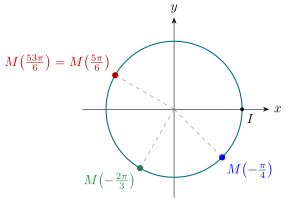
2) Algebraic properties. Knowing that :
- , which belongs to .
- : the principal measure is .
- Since , we have .
- Since , we have .
3) Chasles' relation in two triangles. Since is equilateral and direct and is a direct right isosceles triangle at , we have and . By Chasles' relation: Moreover, , so the triangle is isosceles at , oriented in the positive direction since . Its base angles measure , and since is direct, .
4) Limiting case. We have , so its principal measure is . The real number and the real number have the same image point on the trigonometric circle; to guarantee the uniqueness of the principal measure, the interval is open at and closed at .
What the exercise establishes. The principal measure in is unique (with included and excluded). Reversing the direction of only one vector in adds ; reversing the direction of both vectors does not change the oriented angle. In an isosceles triangle, the sign of the principal measure of the apex angle determines the orientation (direct or indirect) of the base angles.
Similar exercises
- Locating points in polar coordinates and geometric configurations solved
- Fundamental equations in cosine, sine, tangent and cotangent solved
- General equations , and equations on an interval solved
- Trigonometric equations reducing to quadratic equations solved
- Trigonometric inequalities on the circle and sign of a product solved
The course of the chapter · All the exercises of the chapter