Mathematics (Grade 11, Lebanon) · Chapter 13 · Tutorial exercise
Cube, midpoint line and perpendicular planes
Orthogonality in space · A. Orthogonality of lines and planes in common polyhedra · level 2
Statement
In a cube with edge , let be the midpoint of , the midpoint of and the center of the lower face .
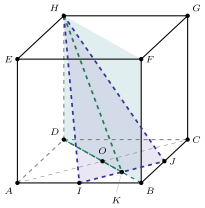
1) Prove that the line is parallel to , then that is orthogonal to the diagonal plane .
2) Deduce that the planes and are perpendicular.
3) Let be the point of intersection of and . Prove that , calculate the lengths , and in terms of , then deduce the exact area of the triangle .
Solution
Strategy. We first use the midpoint theorem in the triangle to transfer the orthogonality properties of the diagonal to , then we notice that the vertex and the point both lie in the plane , which is orthogonal to : is the altitude of the triangle from .
1) Parallelism and orthogonality . In the triangle , and are the respective midpoints of and : by the midpoint theorem, and . Now, in the square , the diagonals are perpendicular: . Moreover, the lateral edge is perpendicular to the plane , so . Since the line is orthogonal to two intersecting lines and of the plane , we have . As , we conclude that .
2) Perpendicularity of the planes and . The plane contains the line , which is orthogonal to the plane by the previous question. Consequently, the planes and are perpendicular.
3) Altitude and area of the triangle .
- The line is orthogonal to the plane and cuts it at . The points and both lie in the plane , so : is the altitude from in the triangle .
- In the square with side , the diagonal is , hence: In the triangle , the midpoint line cuts the median at its midpoint , so . The points , , are collinear in this order on , which gives:
- The triangle is right-angled at since . By the Pythagorean theorem:
- The area of the triangle is therefore:
What the exercise establishes. If two lines are parallel, every plane orthogonal to one of them is orthogonal to the other: replacing a midpoint line by the parallel diagonal immediately simplifies the proofs of orthogonality in the cube.
Similar exercises
- Right prism with a right-triangle base and the theorem of the three perpendiculars solved
- Perpendicular bisector planes, axis of an equilateral triangle and sphere circumscribed about the regular tetrahedron solved
- Orthogonal projection of a vertex in a trirectangular tetrahedron and volume calculated in two ways solved
- Dihedral angle between the base and the lateral faces of a regular pyramid solved
- Common perpendicular and shortest distance between two non-coplanar lines of a cube solved
The course of the chapter · All the exercises of the chapter