Mathematics (Grade 11, Lebanon) · Chapter 13 · Tutorial exercise
Dihedral angle between the base and the lateral faces of a regular pyramid
Orthogonality in space · C. Dihedral angles and common perpendicular to two non-coplanar lines · level 2
Statement
Reminder. Two half-planes with the same boundary form a dihedral angle. If, at the same point of , we draw in each of the two half-planes the ray perpendicular to , the angle formed by these two rays is called a plane angle of the dihedral angle; its measure does not depend on the point chosen on .
Let be a regular pyramid with square base of side and center , such that the height is perpendicular to the plane with . Let be the midpoint of and the midpoint of .
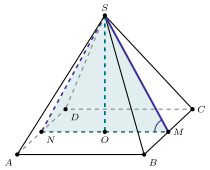
1) Prove that the plane is the common perpendicular bisector plane of the segments and , and that it is perpendicular to the base plane as well as to the two lateral faces and .
2) Justify that the angle is a plane angle of the dihedral angle formed by the base and the lateral face , calculate the lengths and , then determine the measure in degrees of the angle and of the angle .
3) Determine the orthogonal projection of the center onto the lateral face and calculate the distance from to the plane .
Solution
Strategy. To determine the dihedral angle between two planes and intersecting along , we construct the plane orthogonal to the edge : it cuts out on the two planes the rays and perpendicular to , which form the plane angle .
1) Perpendicular bisector plane and perpendicular planes.
- In the square , the line joining the midpoints of the opposite sides and is the common perpendicular bisector of and in : we therefore have , and .
- Since , we have , and the right triangles and are congruent (). The plane , which passes through the midpoint of and contains two intersecting lines and orthogonal to , is orthogonal to : it is the perpendicular bisector plane of (and likewise of since ).
- Since contains , we have ; since with , we also have (and ).
2) Plane angle and measures of angles.
- The planes and intersect along . In the plane , orthogonal to at , the lines and are both perpendicular to at : the angle is therefore the plane angle of the dihedral angle between the base and the face .
- In the square with side , we have and . In the triangle , right-angled at : and , hence .
- By symmetry, and : the triangle is equilateral with side , so the angle between the two opposite lateral faces and is .
3) Distance from the center to the face . Let be the orthogonal projection of onto the line in the plane . Since and , we have . The line , perpendicular to two intersecting lines and of the plane , is orthogonal to the plane : is therefore the orthogonal projection of onto . In the triangle , right-angled at :
What the exercise establishes. When a plane of symmetry is orthogonal to the edge of an oblique face , all the 3D geometry (dihedral angle, apothem , distance from a point of to the plane ) can be read in the plane figure of the triangle .
Similar exercises
- Cube, midpoint line and perpendicular planes solved
- Perpendicular bisector planes, axis of an equilateral triangle and sphere circumscribed about the regular tetrahedron solved
- Orthogonal projection of a vertex in a trirectangular tetrahedron and volume calculated in two ways solved
- Common perpendicular and shortest distance between two non-coplanar lines of a cube solved
- Problem: Pyramidal roof frame of a heritage pavilion in Mount Lebanon and orthogonal guying solved
The course of the chapter · All the exercises of the chapter