Mathematics (Grade 11, Lebanon) · Chapter 13 · Tutorial exercise
Problem: Pyramidal roof frame of a heritage pavilion in Mount Lebanon and orthogonal guying
Orthogonality in space · C. Dihedral angles and common perpendicular to two non-coplanar lines · level 3 (hard)
Statement
The asymmetric roof frame of a dressed-stone pavilion in Mount Lebanon has the shape of a pyramid whose base is a horizontal rectangle with sides and , and whose vertical mast is perpendicular to the base plane with .
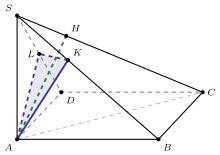
1) Study of the faces of the roof frame and of the lengths of the edges:
- a) Justify that the triangles , and are right-angled at , then prove that the triangle is right-angled at and that the triangle is right-angled at .
- b) Calculate the exact lengths , , and .
2) To stiffen the structure, a cable connects the foot to the orthogonal projection of onto the edge , and a second cable connects to the orthogonal projection of onto the edge .
- a) Prove that the line is orthogonal to the plane , and deduce that . Calculate the lengths and .
- b) Prove in the same way that the line is orthogonal to the plane and that , then calculate the lengths and .
- c) Deduce that the long edge is orthogonal to the plane , that the point of intersection of with the plane is the orthogonal projection of onto , and calculate the exact length .
3) Sphere circumscribed about the roof frame: prove that the five vertices lie on the same sphere , giving a diameter, the center and the exact radius of this sphere.
Solution
Strategy. This problem goes through three successive levels of orthogonality: from we deduce by the theorem of the three perpendiculars that and ; the altitudes and of these two faces then become orthogonal to the adjacent faces and , which implies .
1) Right triangles and lengths of the edges.
- a) Since is perpendicular to the plane at , the line is perpendicular to the lines , and contained in : the triangles , and are therefore right-angled at . In the rectangle , we have ; moreover, implies . The line is therefore orthogonal to two intersecting lines and of the plane : thus , and in particular , so the triangle is right-angled at . Similarly, and imply , hence : the triangle is right-angled at .
- b) Applying the Pythagorean theorem:
- in , right-angled at : ;
- in , right-angled at : ;
- in , right-angled at : ;
- in , right-angled at : .
2) Orthogonal guying and distance from to the edge .
- a) By construction, and . Moreover, since and , we have . The line is therefore orthogonal to two intersecting lines and of the plane : we deduce that , and since , we have . In the triangle , right-angled at (, , ):
- b) Likewise, by definition of , and implies since . The line is therefore orthogonal to two intersecting lines and of the plane : , and in particular . In the triangle , right-angled and isosceles at (), the orthogonal projection of onto the hypotenuse is the midpoint of , hence:
- c) By a) and b), the line is orthogonal to the two intersecting lines and of the plane : consequently, . If denotes the point of intersection of with the plane , the line is contained in , so at : is the orthogonal projection of onto . In the triangle , right-angled at (, , ), the altitude is:
3) Sphere circumscribed about the pyramid . By question 1)a), the three triangles , and have the same hypotenuse and are right-angled at , at and at respectively: The points therefore all lie on the sphere with diameter . The five vertices thus lie on the sphere whose center is the midpoint of and whose radius is:
What the exercise establishes. In every pyramid with rectangular base such that , the longest edge is seen at a right angle from the three other vertices (the three-dimensional analogue of the circle having the hypotenuse as a diameter), and it is orthogonal to the plane passing through and its orthogonal projections onto and .
Similar exercises
- Cube, midpoint line and perpendicular planes solved
- Perpendicular bisector planes, axis of an equilateral triangle and sphere circumscribed about the regular tetrahedron solved
- Orthogonal projection of a vertex in a trirectangular tetrahedron and volume calculated in two ways solved
- Dihedral angle between the base and the lateral faces of a regular pyramid solved
- Common perpendicular and shortest distance between two non-coplanar lines of a cube solved
The course of the chapter · All the exercises of the chapter