Mathematics (Grade 11, Lebanon) · Chapter 14 · Tutorial exercise
A basis of face diagonals and its orientation
Vectors and coordinate systems in space · B. Bases, coordinate systems, coordinates and orientation · level 2
Statement
Let be a cube with edge such that the orthonormal coordinate system is direct (right-handed). Consider the three face diagonals from : , and .
1) Express , , in terms of , , . Show that is a basis of space.
2) Show that .
3) Decompose , and in the basis , then give the coordinates of the points , and in the coordinate system .
4) Using Ampère's observer rule (or the right-hand rule), give the orientation of the basis , then that of the basis .
5) Limiting case. Is the triple a basis? Interpret geometrically.
Solution
Strategy. We work in the known basis . To prove that three vectors form a basis, we assume that one of them is a combination of the other two and arrive at an inconsistent system. To decompose, we cleverly combine the three equalities.
1) A basis. By the parallelogram rule in the faces: , , . The first two are not collinear (one has no component on , the other has one). Suppose . By uniqueness of the decomposition: , , , which is impossible. The three vectors are not coplanar: they form a basis.
2) The long diagonal. (parallelepiped rule), hence .
3) The edges and the coordinates. We subtract from the diagonal of the face that does not contain the required edge: ; ; . The coordinates of a point in the coordinate system are those of in the new basis: , , .
4) The orientation. Since is direct, an Ampère observer through whom passes from feet to head, looking in the direction of , sees on his left. When passes through him and he looks toward , the vector points to his left: the basis is direct. Swapping the last two vectors, the basis is therefore indirect.
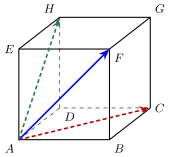
5) Limiting case: three diagonals in the same plane. : is a linear combination of and . The three vectors are coplanar; it is not a basis. Geometrically, , , are the sides of the triangle : they all lie in the plane . Three vectors taken along the sides of the same triangle never form a basis.
What the exercise establishes. Three non-coplanar vectors form a basis, whatever their shape: the edges of a cube, but also three face diagonals from the same vertex. Proving that they form a basis means showing that none of them is a combination of the other two, using uniqueness in an already known basis. Swapping two vectors of a basis reverses its orientation.
Similar exercises
- A midpoint, a parallel line solved
- A plane parallel to two opposite edges solved
- Finding points of a line solved
- The medians of a tetrahedron solved
- Problem: the lattice pylon solved
The course of the chapter · All the exercises of the chapter