Mathematics (Grade 11, Lebanon) · Chapter 14 · Tutorial exercise
A plane parallel to two opposite edges
Vectors and coordinate systems in space · A. Vector calculus, collinearity and coplanarity · level 2
Statement
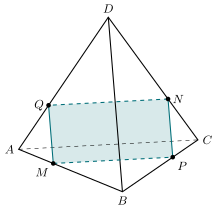
Let be a tetrahedron. Place on with , on with , on with and on with .
1) Show that . What can be deduced about the vectors , , ?
2) Show that . Deduce that , , , are coplanar and that is a parallelogram.
3) Show that . Deduce that the lines and are parallel to the plane .
4) Are the vectors , , coplanar?
5) Limiting case. For a real number in , place and such that and . Show that . What happens for and for ?
Solution
Strategy. We decompose each vector by Chasles' relation, going through vertices, then we express everything in the basis to compare. Two equal vectors carried by opposite sides make a parallelogram.
1) The vector . , and , so On the other hand, gives the same expression. So : the three vectors , , are coplanar, although the lines and are not coplanar.
2) The parallelogram. . . So : is a parallelogram (non-degenerate, since is not on ), and its four vertices lie in the same plane.
3) The two directions. . The plane has direction vectors and , which are not collinear. The line , with direction vector , is therefore parallel to the plane , and likewise : the plane is parallel to the two opposite edges and .
4) A non-coplanarity. If were a combination , its coefficient on would be zero; but it is . By uniqueness of the decomposition, , , are not coplanar (they form a basis).
5) Limiting case: a whole family of planes. . For each , the line is parallel to the plane directed by and . For , and : . For , and : . The segment “turns” from the edge to the edge while remaining parallel to the same plane.
What the exercise establishes. Coplanarity is proved by writing one vector as a combination of two others, often by Chasles' relation with a detour through vertices. Two non-coplanar lines, such as and , nevertheless have direction vectors that, together with a third one, can be coplanar: coplanarity is a matter of directions, not of position. A plane parallel to two opposite edges of a tetrahedron cuts it along a parallelogram.
Similar exercises
- The four diagonals of a rectangular prism solved
- A midpoint, a parallel line solved
- A basis of face diagonals and its orientation solved
- Finding points of a line solved
- The medians of a tetrahedron solved
The course of the chapter · All the exercises of the chapter