Mathematics (Grade 11, Lebanon) · Chapter 14 · Tutorial exercise
Problem: the lattice pylon
Vectors and coordinate systems in space · B. Bases, coordinate systems, coordinates and orientation · level 3 (hard)
Statement
A telecommunications antenna is carried by a metal lattice pylon made of identical stacked modules. Each module has the shape of a parallelepiped (bases at the bottom and at the top). To stiffen it, a diagonal bar and two triangular bracing plates are welded on, one along the triangle , the other along the triangle . The bar crosses the two plates; we want to know where, in order to drill the through-holes there. Let , , .
1) Express in terms of , , . Let be the point of such that . Show that and deduce that is in the plane .
2) Let be the midpoint of . Show that . What is for the triangle ?
3) Let be a point of the line , with . Suppose that is in the plane , that is . By decomposing both sides in the basis , show that . Conclude.
4) Let be the point of such that . Show that , then that is the centroid of the triangle and the only point of in the plane .
5) Deduce the rule of thirds: .
6) Limiting case. Show that and . What can be deduced about the planes and ? Does the result depend on the shape of the module (cube, rectangular prism, arbitrary parallelepiped)?
Solution
Strategy. Everything is expressed in the basis of the three edges from . To show that a point is in a plane, we write a vector as a combination of two direction vectors; to show that it is the only point of a line in this plane, we identify the coefficients thanks to the uniqueness of the decomposition.
1) The first crossing point. By the parallelepiped rule, . Then On the other hand, and , so : it is the same expression. Thus , and is in the plane .
2) The centroid. is the midpoint of , so and . The point is on the median , two thirds of the way from : is the centroid of the triangle .
3) A single crossing point. and . By uniqueness of the decomposition in the basis : So , that is (and ). The line cuts the plane at a single point: . The through-hole in the first plate is at the centroid of the triangle.
4) The second crossing point. . Now and , so : is in the plane . With the midpoint of , : is the centroid of . Finally, if and , identification gives , and , hence , that is : is the only point of in this plane.
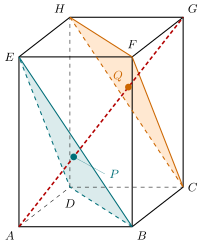
5) The rule of thirds. , and : the three vectors are equal, so The long diagonal of a parallelepiped crosses the triangles and at their centroids, and these two points divide it into three equal segments. For the pylon, the holes are drilled at the centroid of each plate, and the bar is divided into three sections of the same length.
6) Limiting case: two parallel plates, whatever the module. and (calculated above). The two planes therefore have two non-collinear direction vectors in common: the planes and are parallel; they are distinct since . No calculation used a length or a right angle: the rule of thirds holds for a cube, a rectangular prism or an arbitrary parallelepiped, hence for every module of the pylon, even tilted or deformed into a parallelepiped.
What the exercise establishes. To locate a point with respect to a plane, we decompose in a basis: belonging to the plane means being of the form . The uniqueness of the decomposition turns the search for the intersection of a line and a plane into a small system, whose unique solution proves that there is only one common point. A result obtained without lengths or angles remains true for all shapes of parallelepipeds.
Similar exercises
- A midpoint, a parallel line solved
- A plane parallel to two opposite edges solved
- A basis of face diagonals and its orientation solved
- Finding points of a line solved
- The medians of a tetrahedron solved
The course of the chapter · All the exercises of the chapter