Mathematics (Grade 11, Lebanon) · Chapter 14 · Tutorial exercise
The four diagonals of a rectangular prism
Vectors and coordinate systems in space · A. Vector calculus, collinearity and coplanarity · level 1 (application)
Statement
Let be a rectangular prism. Let , and .
1) Simplify (a) ; (b) ; (c) .
2) Express the vectors , , and (the four long diagonals) in terms of , , .
3) Show that .
4) Let be the midpoint of . Express in terms of , , , then show that is also the midpoint of , of and of .
5) Show that and interpret this result in the quadrilateral .
6) Limiting case. Show that, for every point of space, . What does this sum become if ?
Solution
Strategy. We replace each vector by an equal vector chosen so as to chain Chasles' relations; for the diagonals, we start from and follow edges. Once all the vectors are written with , , , the sums are calculated like polynomials.
1) The simplifications. (a) By Chasles' relation, . (b) Likewise, . (c) . In each case, the endpoint of one vector is the initial point of the next.
2) The diagonals. We follow edges:
- ;
- ;
- ;
- .
3) The sum of the diagonals. Adding: the coefficients of give , those of give , those of give . So
4) The common point. . Let be the midpoint of : , so . Likewise, and : the four long diagonals have the same midpoint , the center of the rectangular prism.
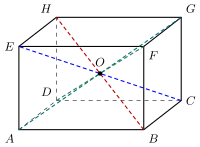
5) The parallelogram . , so . Interpretation: , so is a parallelogram (a rectangle in a rectangular prism), whose diagonals are and ; the relation says that the sum of the two diagonals, directed from to and from to , equals twice the side , as in every parallelogram.
6) Limiting case: eight vertices, one center. For every point , since is the midpoint of , ; likewise , and . Adding these four equalities, the sum of the eight vectors equals . If , it is zero: . The center “balances” the eight vertices.
What the exercise establishes. In a parallelepiped, the twelve edges give only three different vectors (up to sign), , , ; every vector joining two vertices is written with them by following edges. Once the vectors are written in the basis , the sums are calculated coefficient by coefficient. Two points coincide when the vectors leading to them from are equal: this is how we prove that segments have the same midpoint.
Similar exercises
- A midpoint, a parallel line solved
- A plane parallel to two opposite edges solved
- A basis of face diagonals and its orientation solved
- Finding points of a line solved
- The medians of a tetrahedron solved
The course of the chapter · All the exercises of the chapter