Mathematics (Grade 11, Lebanon) · Chapter 15 · Tutorial exercise
Area of a parallelogram, altitude of a triangle and distance to a line
Scalar product and cross product · B. Cross product, areas and distances in space · level 2
Statement
In oriented space referred to a right-handed orthonormal coordinate system , consider the points , and .
1) Calculate the coordinates of , of and of the cross product . Deduce that , , are not collinear.
2) Determine the coordinates of the point such that is a parallelogram, then calculate the area of the parallelogram and the area of the triangle .
3) Calculate the length and deduce the distance from the point to the line (that is, the length of the altitude from in the triangle ).
4) Find this distance again by determining the coordinates of the orthogonal projection of onto the line .
5) Limiting case. Let be any point of the line through with direction vector , defined by (). Calculate and explain geometrically why the area of the triangle does not depend on .
Solution
Strategy. The norm of immediately gives the area of the parallelogram , and half of it gives the area of the triangle . Writing that the area of the parallelogram is also , we get the distance from to without needing the coordinates of the foot of the altitude.
1) Cross product. We have and , hence: Since , the vectors and are not collinear: , , are not collinear.
2) Parallelogram and areas. is a parallelogram if and only if , which gives . The area of the parallelogram is: The area of the triangle is half of it: .
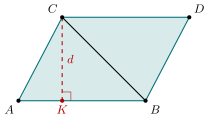
3) Distance from to the line . We have . Since , we get directly:
4) Check with the orthogonal projection . A point of satisfies , so . The condition reads: Then , and : we find exactly the same distance, but the cross product avoids looking for .
5) Limiting case: moving parallel to . If , then . By distributivity and since : The cross product — and hence the area — remains invariant: all these triangles have the same base and their vertex moves along a parallel to , hence at the constant distance from the line .
What the exercise establishes. To calculate the distance from a point to a line in space, the formula is much faster than calculating the coordinates of the orthogonal projection of onto .
Similar exercises
- Triangle in space, Al-Kashi formula and median theorem solved
- Normal vector, Cartesian equation of a plane and orthogonal projection solved
- Constructing a right-handed orthonormal basis and Lagrange's identity solved
- Vector equation in oriented space solved
- Problem: the trirectangular tetrahedron and de Gua's theorem solved
The course of the chapter · All the exercises of the chapter