Mathematics (Grade 11, Lebanon) · Chapter 15 · Tutorial exercise
Problem: the trirectangular tetrahedron and de Gua's theorem
Scalar product and cross product · B. Cross product, areas and distances in space · level 3 (hard)
Statement
In crystallography as in strength of materials, the truncated corner of a rectangular block is modeled by a trirectangular tetrahedron : the three edges , , from the vertex are pairwise perpendicular, with respective lengths , , (). Space is equipped with the right-handed orthonormal coordinate system such that , and .
1) Give the coordinates of the vertices , , and express the areas , and of the three faces right-angled at in terms of , , .
2) Calculate the scalar products , and . What do we deduce about the three angles of the triangle ?
3) Calculate the coordinates of the cross product . Deduce the area of the oblique face and prove de Gua's theorem:
4) Show that the vector is normal to the plane and that this plane has Cartesian equation . Let be the orthogonal projection of onto the plane ; noticing that and , show that , then that is the orthocenter of the triangle .
5) Numerical application for , , . Calculate , the coordinates of and the altitude of the tetrahedron from , then check the relation:
6) Limiting case. When , what is the nature of the triangle ? Check that and give the position of in the triangle .
Solution
Strategy. The right-handed orthonormal coordinate system attached to the three edges perpendicular at places , , on the three coordinate axes. The scalar product immediately reveals the sign of the cosines of the angles of , while the cross product yields both the area of the oblique face and a vector normal to the plane .
1) Coordinates and areas of the right-angled faces. In the coordinate system , we have , , and . The triangles , and are right-angled at , with respective areas:
2) The oblique face is always an acute triangle. We have , and . We calculate: Since the three scalar products are strictly positive, the cosines of the three angles , and are strictly positive: the three angles of the triangle are always acute, whatever the lengths , , .
3) Cross product and de Gua's theorem. Let us calculate in the right-handed orthonormal basis: The area of the triangle is . Squaring: This is de Gua's theorem: in a tetrahedron trirectangular at , the square of the area of the face opposite is equal to the sum of the squares of the areas of the three faces right-angled at .
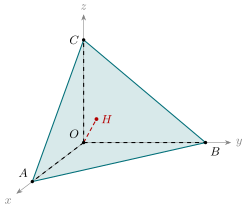
4) Equation of the plane and orthocenter . The vector is normal to the plane . The equation reads , that is, dividing by : Let be the orthogonal projection of onto : the line is perpendicular to the plane , so . Moreover, is orthogonal to and to , hence to : . By Chasles' relation: The line , lying in the plane , is perpendicular to the side : it is the altitude from in the triangle . The same calculation gives and : is the orthocenter of the triangle .
5) Numerical application for , , .
- The areas of the right-angled faces are , , , so .
- The equation of is , with reduced normal vector .
- Since , the point satisfies , that is and .
- The distance is . We then check:
6) Limiting case: . If , then : the triangle is equilateral. Each of the three right-angled faces has area , and de Gua's theorem gives . The orthocenter then coincides with the centroid and the circumcenter of the equilateral triangle .
What the exercise establishes. In a trirectangular tetrahedron, choosing the right-handed orthonormal coordinate system carried by the three edges from the right angle makes all the calculations transparent: the cross product proves de Gua's theorem in two lines and gives the vector normal to the plane , while the scalar product proves effortlessly that the foot of the altitude from is the orthocenter of the oblique face.
Similar exercises
- Triangle in space, Al-Kashi formula and median theorem solved
- Normal vector, Cartesian equation of a plane and orthogonal projection solved
- Constructing a right-handed orthonormal basis and Lagrange's identity solved
- Area of a parallelogram, altitude of a triangle and distance to a line solved
- Vector equation in oriented space solved
The course of the chapter · All the exercises of the chapter