Mathematics (Grade 11, Lebanon) · Chapter 15 · Tutorial exercise
Scalar products and orthogonal lines in a cube
Scalar product and cross product · A. Scalar product, angles, orthogonality and planes in space · level 1 (application)
Statement
Let be a cube with edge (lower base , upper base , vertical edges , , , ). All the calculations asked for in this exercise are done without coordinates, by orthogonal projection or by vector decomposition.
1) Using orthogonal projection or scalar squares, calculate , and .
2) What is the nature of the triangle ? Deduce the scalar product in terms of .
3) Decomposing and , calculate then .
4) Deduce that the long diagonal is orthogonal to every line of the plane .
5) Limiting case. What is the scalar product when moves over the triangle ? Interpret geometrically.
Solution
Strategy. Without a coordinate system, we have three tools: replace a vector by its orthogonal projection onto the line of the other; recognize a special triangle whose sides and angles we know; or decompose the vectors along three pairwise orthogonal edges (, , ) whose mutual scalar products are zero and whose scalar squares equal .
1) The first three scalar products.
- The plane is perpendicular to the edge at , so the orthogonal projection of onto is : .
- By Chasles' relation, . Since , we get .
- The vectors and are equal, with norm (diagonal of a square with side ): .
2) The equilateral triangle . The segments , and are the diagonals of three square faces with side : . The triangle is therefore equilateral and the angle measures . Thus:
3) Orthogonality with and . The vectors , , are pairwise orthogonal with scalar square . By bilinearity: Likewise, with :
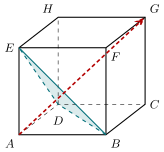
4) Orthogonality to all the lines of the plane . The vectors and are not collinear and direct the plane . Every direction vector of a line of this plane can be written (), so . The line is orthogonal to every line of the plane : it is perpendicular to the plane .
5) Limiting case: moving in the plane . For every point of the plane , the vector is a linear combination of and , so . Thus, all the points of the plane have the same orthogonal projection onto the line : it is the point of intersection of with the plane .
What the exercise establishes. In a cube or a rectangular prism, decomposing the vectors along three edges from the same vertex reduces every scalar product to the squares of the lengths of these three edges, since the cross terms vanish by orthogonality. To prove that a line is perpendicular to a plane, it is enough to check that its direction vector has a zero scalar product with two non-collinear vectors of this plane.
Similar exercises
- Triangle in space, Al-Kashi formula and median theorem solved
- Normal vector, Cartesian equation of a plane and orthogonal projection solved
- Constructing a right-handed orthonormal basis and Lagrange's identity solved
- Area of a parallelogram, altitude of a triangle and distance to a line solved
- Vector equation in oriented space solved
The course of the chapter · All the exercises of the chapter