Mathematics (Grade 11, Lebanon) · Chapter 16 · Tutorial exercise
Addition principle, multiplication principle and routes in stages
Arrangements and permutations · A. Multiplication principle and factorial notation · level 2
Statement
A road network connects three cities , and . There are ~distinct roads directly connecting to (denoted ), ~distinct roads directly connecting to (denoted ), and ~coastal roads directly connecting to without going through (denoted ).
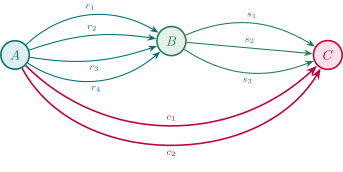
1) How many different routes are there to go from to (going through or not)?
2) How many round trips are there, going through both on the way out and on the way back?
3) How many round trips are there that use, on the way back, neither of the two roads used on the way out?
Solution
Strategy. We carefully distinguish the connective “or” between two disjoint families of trips (which falls under the addition principle) and the connective “then” between the successive stages of the same trip (which falls under the multiplication principle).
1) One-way trips from to . The set of routes from to is the disjoint union of two subsets:
- the routes going through , made up of the choice of a road from to (~choices) then a road from to (~choices), that is ~routes by the multiplication principle;
- the direct routes from to without going through , of which there are . By the addition principle, the total number of routes from to is:
2) Round trip via without constraint. The trip breaks down into ~successive stages: (~choices), (~choices), (~choices) and (~choices). By the multiplication principle:
3) Round trip via without reusing the roads of the way out.
- On the way out, there are still ~choices for and ~choices for .
- On the way back, the road taken between and on the way out is forbidden: only ~choices remain for the stage . Likewise, the road taken between and on the way out is forbidden: ~choices remain for the stage . By the multiplication principle:
What the exercise establishes. When a procedure involves both mutually exclusive alternatives (“go through ” or “take the coastal road”) and successive stages (“go from to ” then “go from to ”), we apply the multiplication principle within each alternative, then add the cardinalities of the disjoint alternatives.
Similar exercises
- Factorial simplifications, telescoping sums and equations in solved
- Four-digit numbers with parity and order constraints solved
- Successive draws of tokens and the complement method solved
- Permutations with grouped blocks and alternating categories solved
- Anagrams with repetitions and constraints on the ends solved
The course of the chapter · All the exercises of the chapter