Mathematics (Grade 11, Lebanon) · Chapter 3 · Tutorial exercise
Problem: Transformation of the complex plane and loci
Complex numbers · C. Geometry in the complex plane and synthesis problem · level 3 (hard)
Statement
In the complex plane equipped with a direct orthonormal coordinate system , consider the points and with respective affixes: With every point of the plane with affix , we associate the point with affix defined by:
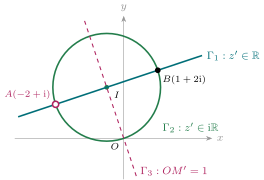
1) Calculating images and preimages.
- a) Calculate in algebraic form the affix of the image of the origin .
- b) Determine the affix of the point whose image has affix .
- c) Determine the invariant points of the transformation, that is the points such that .
2) Setting with , prove that the real and imaginary parts of are given by:
3) Deduce the precise geometric nature:
- a) of the set of points such that is a real number;
- b) of the set of points such that is a pure imaginary.
4) Show that for every , the condition is equivalent to , then determine the Cartesian equation and the geometric nature of the set of points such that .
5) Check that the circle passes through the origin and determine the coordinates of the points of intersection of and .
Solution
Strategy. We combine the algebra of complex numbers (inverting the homographic map, solving a second-degree equation in for the fixed points, multiplying by the conjugate of the denominator to obtain and ) and the geometric interpretation in the complex plane.
1) Images, preimages and invariant points.
- a) For :
- b) For , let us solve : Dividing by :
- c) For , the equation for the invariant points can be written: The discriminant of this second-degree equation is: Let us find such that . With , we obtain and (), that is , which gives two invariant points with affixes .
2) Real and imaginary parts of . For : Let us calculate the real part and the imaginary part of the numerator:
- Real part: .
- Imaginary part: .
Thus:
3) Sets and .
- a) with with . Now the coordinates of and of satisfy and . The set is therefore the line with equation , with the point removed.
- b) with , which can be written in canonical form: We recognize the circle with center (midpoint of ) and radius . The set is therefore the circle with diameter , with the point removed.
4) Set defined by . We know that . Now: Thus : the set is the perpendicular bisector of the segment . Analytically: which is the line passing through the origin and the midpoint .
5) Passing through and intersection of and .
- The coordinates of make hold (and we had found in question 1)a)), so .
- Let us find the points of intersection of () and () by replacing by in the equation of the circle: We thus obtain the two diametrically opposite points on : the origin and the point .
What the exercise establishes. For any homographic transformation (), the set of points such that is the line with removed, the set of points such that is the circle with diameter with removed, and the set of points such that is the perpendicular bisector of .
Similar exercises
- Properties of the conjugate and equations in and solved
- Biquadratic equation in and factorization into real trinomials solved
- Square roots and second-degree equations with complex coefficients solved
- Polynomial of degree three with complex coefficients and triangle in the complex plane solved
- Geometric configurations, distances and circumscribed circle solved
The course of the chapter · All the exercises of the chapter