Mathematics (Grade 12 General Sciences, Lebanon) · Chapter 1 · Tutorial exercise
Auxiliary function, implicit root and sign of a derivative
Continuity and the intermediate value theorem · B. Image of an interval, the intermediate value theorem and the bijection theorem · level 2
Statement
Part A — Study of an auxiliary function. Let be the function defined on by:
- Study the variations of on and give its limits at and .
- Prove that the equation has a unique real solution , and check that .
- Deduce the sign table of on .
Part B — Application to the study of a rational function. Consider the function defined on by:
- Show that, for every , the derivative of can be written:
- Study the sign of on in terms of and draw up the table of variations of .
- Prove that , then use the bound for to give a bound for of width .
Solution
Part A — Auxiliary function .
1. Variations of . The polynomial function is continuous and differentiable on , and for every : The function is therefore strictly increasing on . Since the highest-degree term dominates:
2. Existence, uniqueness and bounding of .
- The function is continuous and strictly increasing on , so . Since , by the bijection theorem, the equation has a unique real solution .
- Let us compute and : Since is strictly increasing on and , we conclude:
3. Sign of on . Since is strictly increasing on and :
- for ;
- ;
- for .
Part B — Study of the function .
1. Computing . The rational function is differentiable on (since ). For every : that is, .
2. Sign of and table of variations of . Since the denominator is positive on , the sign of is that of the product , with :
- on , and , so ;
- on , and , so ;
- on , and , so .
Moreover, and, factoring out the highest-degree terms, for , hence and .
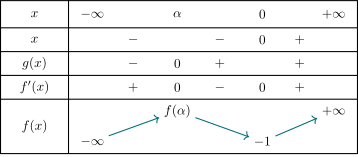
The function is strictly increasing on , strictly decreasing on and strictly increasing on ; it has a local maximum at and a local minimum at .
3. The identity and bounding. By definition of , we have , that is, . Let us put everything over a common denominator: So . Since and multiplying by preserves the direction of inequalities: This is a bound for of width .
What the exercise establishes.
- Study the sign of a derivative whose numerator has degree by introducing an auxiliary function, then lower the degree of the expression of by replacing using the implicit relation .
Similar exercises
- Left continuity, right continuity and joining the pieces solved
- Extension by continuity and differentiability of the extension solved
- Image of an interval and number of solutions of an equation with a parameter solved
- Locating a root by bisection and by decimal scanning solved
- Fixed point theorem on a closed interval and intersection of two curves solved
The course of the chapter · All the exercises of the chapter