Mathematics (Grade 12 General Sciences, Lebanon) · Chapter 1 · Tutorial exercise
Image of an interval and number of solutions of an equation with a parameter
Continuity and the intermediate value theorem · B. Image of an interval, the intermediate value theorem and the bijection theorem · level 2
Statement
Let be the function defined on by:
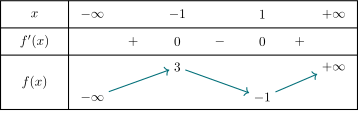
- Justify that is continuous and differentiable on , compute and draw up the complete table of variations of on (giving the limits at and as well as the local extrema).
- Determine, justifying carefully with the continuity and the direction of variation of , the image under of each of the following intervals:
- a) ;
- b) ;
- c) ;
- d) .
- Prove that the equation has exactly three distinct real solutions , and justify that:
- Discuss, according to the values of the real parameter , the number and the sign of the real solutions of the equation .
Solution
1. Study of the variations of . The function is a polynomial, hence continuous and differentiable on . For every : The trinomial vanishes at and , is positive on and negative on . At the ends of , since the highest-degree term dominates: The values at the local extrema are (local maximum) and (local minimum). Hence the table of variations of :
2. Images of the intervals .
- a) Interval . On , the function is continuous and strictly decreasing:
- b) Interval . The function is not monotonic on : it is continuous and strictly increasing on , then continuous and strictly decreasing on . We split the interval into two subintervals of monotonicity: Since , we obtain:
- c) Interval . Let us split :
- On , is continuous and strictly decreasing, so .
- On , is continuous and strictly increasing, with , so . Taking the union, the value (attained at ) belongs to the image:
- d) Interval . Let us split :
- On , is continuous and strictly decreasing with and , hence .
- On , is continuous and strictly increasing with and , hence . Taking the union:
3. Existence, uniqueness on each interval and location of the three roots. Let us apply the bijection theorem on each of the three maximal intervals on which is strictly monotonic:
- On , is continuous and strictly increasing from to . Since , the equation has a unique solution in . Moreover, , so by strict increase: .
- On , is continuous and strictly decreasing from to . Since , the equation has a unique solution in . Moreover, , so by strict decrease: .
- On , is continuous and strictly increasing from to . Since , the equation has a unique solution in . Moreover, , so by strict increase: .
Altogether, the equation has exactly three real solutions satisfying .
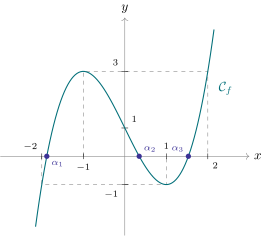
4. Discussion of the number and the sign of the solutions of . Note that , so that the solutions on are negative and those on are positive. Reading off the images of the intervals of monotonicity , , and , we obtain:
| Values of | Number of solutions | Sign of the solutions |
|---|---|---|
| solution | negative solution () | |
| solutions | and (double root of ) | |
| solutions | negative solution and positive solutions | |
| solutions | , and | |
| solutions | negative solutions and positive solution | |
| solutions | (double root of ) and | |
| solution | positive solution () |
What the exercise establishes.
- Never write without having checked the monotonicity of on : when changes direction of variation, split the interval into subintervals of monotonicity and take the union of the images.
- Use the pivot value to determine not only the number but also the sign of the roots of the equation .
Similar exercises
- Left continuity, right continuity and joining the pieces solved
- Extension by continuity and differentiability of the extension solved
- Auxiliary function, implicit root and sign of a derivative solved
- Locating a root by bisection and by decimal scanning solved
- Fixed point theorem on a closed interval and intersection of two curves solved
The course of the chapter · All the exercises of the chapter