Mathematics (Grade 12 General Sciences, Lebanon) · Chapter 1 · Tutorial exercise
Synthesis problem: irrational function with a parameter, extension and bijection
Continuity and the intermediate value theorem · C. Bounding methods, the fixed point theorem and a synthesis problem · level 3 (hard)
Statement
Consider the function defined on by:
Part A — Extension by continuity at the endpoints and .
- Compute the limit of as tends to and show that can be extended by continuity at .
- Show that, for every , setting (), we can write:
- Deduce that has an extension by continuity to the whole of , denoted . State and .
Part B — Analytic study of the extended function .
- Study the differentiability of from the right at by forming the difference quotient for . Interpret the result geometrically for the curve .
- Prove that is differentiable on and that, for every :
- Determine the limit of at , draw up the complete table of variations of on and state the image .
Part C — Solving equations and fixed point.
- Let be a real number. Discuss, according to the values of , the number of solutions on of the equation . When the solution is unique and , determine its exact value.
- Prove that the equation has a unique solution on , justify that and check that satisfies the relations:
Solution
Part A — Extensions by continuity at and at .
1. Limit at . As , we have , so and . As a quotient of finite limits: The function can therefore be extended by continuity from the right at by setting .
2. Factoring with . For every , let with . Then and . We recognize two special products: Since , we have , and the factor cancels:
3. Extension by continuity on . The function is defined and continuous on the whole of because is continuous on and the denominator is greater than or equal to . In particular: The extension by continuity of to is therefore the function defined for every by:
Part B — Analytic study of .
1. Differentiability from the right at . For every , let us compute the difference quotient of between and : (Notable result: the term cancels in the numerator because !) Taking the limit as : Thus, despite the presence of in the expression of , the function is differentiable from the right at and . Geometrically, at the point the curve has a half-tangent with equation .
2. Derivative of on . On , the function is differentiable with derivative . Differentiating a quotient: Let us factor out in the numerator (noting that ): (We can also cancel to write , which indeed tends to at !)
3. Limit at , variations and image . For , let us factor out in the denominator: The line with equation is a horizontal asymptote to at . Since for every , the function is continuous and strictly decreasing on .
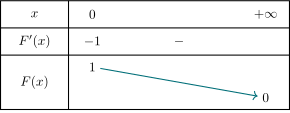
The image of under the continuous and strictly decreasing function is therefore:
Part C — Equations and fixed point.
1. Discussion of the equation . By the bijection theorem, is a bijection from onto :
- If (that is, or ), the equation has no solution on .
- If , the equation has a unique solution on .
For , let us solve by setting : The discriminant is . The roots are (rejected since ) and . Hence , that is, the unique solution .
2. Fixed point of . Let on . Since is continuous and strictly decreasing and is continuous and strictly decreasing, is continuous and strictly decreasing on , from to . It therefore vanishes at a unique real number . Moreover:
- .
- For , we have ; multiplying the numerator and the denominator by , then by the conjugate quantity : hence .
Consequently, and, since is strictly decreasing, . Since ( and ), the equality can be written with the original expression: Since both sides are positive (because ), we can square: .
What the exercise establishes.
- Factor an irrational expression by setting in order to remove an indeterminacy at , study differentiability at and characterize the bijection from onto , all at once.
Similar exercises
- Extension by continuity and differentiability of the extension solved
- Image of an interval and number of solutions of an equation with a parameter solved
- Auxiliary function, implicit root and sign of a derivative solved
- Locating a root by bisection and by decimal scanning solved
- Fixed point theorem on a closed interval and intersection of two curves solved
The course of the chapter · All the exercises of the chapter