Mathematics (Grade 12 General Sciences, Lebanon) · Chapter 2 · Tutorial exercise
Bijection, explicit computation of the inverse and symmetry of the curves
Composite functions and inverse functions · B. Inverse functions · level 2
Statement
Let be the function defined on the interval by:
- Prove that is a bijection from onto an interval to be determined.
- For every , solve the equation with unknown , and deduce the explicit expression of the inverse function for every .
- State the direction of variation, the continuity and the domain of differentiability of on .
- Compute in two different ways:
- a) using the formula for the derivative of the inverse function ;
- b) by directly differentiating the explicit expression of found in question 2.
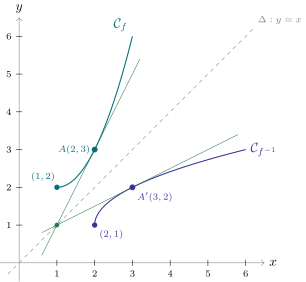
- In the same orthonormal coordinate system , draw the line , the curve , the curve and their respective tangents at the symmetric points and .
Solution
1. Bijection from onto . The polynomial function is continuous and differentiable on . For every : We have and for every . The function is therefore continuous and strictly increasing on . By the bijection theorem, it is a bijection from onto the interval:
2. Explicit expression of . Let and . Let us write in canonical form: Hence, for (that is, ) and (that is, ): We thus obtain . Renaming the dummy variable , the inverse function is defined by:
3. Properties of on . By the general properties of inverse functions:
- is continuous on and strictly increasing on (same direction of variation as ).
- Since (with ) and for every , the function is differentiable on but is not differentiable at (at the point the curve has a vertical half-tangent, the reflection of the horizontal half-tangent of at the point ).
4. Computing by both methods.
- a) Using the formula for the inverse: let us look for the unique preimage of under . We notice that , so . Since , the function is differentiable at and:
- b) By direct differentiation: for every , we have . At :
5. Graphical representation and symmetry with respect to . The tangent to at has equation , and the tangent to at has equation (they intersect on at the point ).
What the exercise establishes.
- Go through the canonical form to extract the preimage cleanly, choosing the sign of the square root according to the target interval , and link the vanishing of to the existence of a vertical half-tangent for at .
Similar exercises
- Domain, limits and direction of variation of a composite function solved
- Differentiating composite functions and study of a trigonometric function solved
- Differentiating an inverse function that cannot be found algebraically solved
- -th roots, rational exponents and irrational equations solved
- Trigonometric bijection and inverse function solved
The course of the chapter · All the exercises of the chapter