Mathematics (Grade 12 General Sciences, Lebanon) · Chapter 2 · Tutorial exercise
Domain, limits and direction of variation of a composite function
Composite functions and inverse functions · A. Operations on composite functions · level 1 (application)
Statement
Consider the two functions and defined respectively by: Let denote the composite function defined by .
- Determine carefully the domain of the composite function .
- Study the variations of the function on each of the intervals making up , and check that for every :
- Using the theorem on the limit of a composite function, determine the limits of at , at and to the left of (). State the corresponding asymptotes to the curve .
- Without computing the derivative , deduce from the direction of variation of and that of the direction of variation of on each of the intervals of .
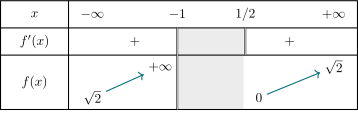
- Compute for every , study the differentiability of at and draw up the complete table of variations of .
Solution
1. Determining the domain . By definition of the composite function , a real number belongs to if and only if: The quotient vanishes at , changes sign at and at , and is positive outside the roots:
2. Canonical decomposition and variations of . For every , we have: The function is differentiable on and on , with derivative: The function is therefore strictly increasing on and strictly increasing on .
3. Limits of at the endpoints of .
- At and at : we have . Since the function is continuous at , the theorem on the composition of limits gives: The line with equation is therefore a horizontal asymptote to at and at .
- At : as with , we have and , so . Since , by composition: The line with equation is a vertical asymptote to .
4. Direction of variation by composition.
- On , the function is strictly increasing with values in , and the function is strictly increasing on . As the composition of two strictly increasing functions, is strictly increasing on .
- On , the function is strictly increasing with values in , and is strictly increasing on . By composition, is strictly increasing on .
5. Derivative and differentiability at . On , the function is differentiable and positive (). By the formula , the function is differentiable and: At , we have . For , the difference quotient is: The function is therefore not differentiable at , and at the point the curve has a vertical half-tangent pointing upward.
What the exercise establishes.
- Always check the inclusion condition to define , and distinguish the domain of continuity () from the domain of differentiability of ( strictly).
Similar exercises
- Differentiating composite functions and study of a trigonometric function solved
- Bijection, explicit computation of the inverse and symmetry of the curves solved
- Differentiating an inverse function that cannot be found algebraically solved
- -th roots, rational exponents and irrational equations solved
- Trigonometric bijection and inverse function solved
The course of the chapter · All the exercises of the chapter