Mathematics (Grade 12 General Sciences, Lebanon) · Chapter 2 · Tutorial exercise
Synthesis problem: study of an irrational bijection and of its inverse
Composite functions and inverse functions · C. -th root functions, rational powers and synthesis problem · level 3 (hard)
Statement
Consider the function defined on by: Let denote its representative curve in an orthonormal coordinate system .
Part A — Asymptotic study and bijection.
- Prove that, for every , we have and the identity:
- Deduce the limits of at and at . State the asymptote to at .
- Show that the line with equation is an oblique asymptote to at , and state the relative position of with respect to on .
- Compute for every , check that , and deduce that is a bijection from onto .
Part B — Determination and study of the inverse function .
- Let and . Using the relation and the identity of question A.1, prove that:
- Check the differentiation formula for every (with ), by expressing each of the two sides in terms of .
- Solve in the inequality .
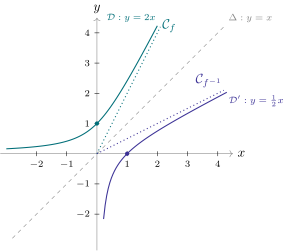
- In the orthonormal coordinate system , draw the lines , , as well as the curves and .
Solution
Part A — Study of and bijection from onto .
1. Positivity and conjugate identity. For every , we have , so, since the square root function is strictly increasing on , we have . We deduce that for every . Moreover, multiplying conjugate expressions: It follows immediately that for every :
2. Limits at and at .
- At , we have and , so, as a sum:
- At , the form is an indeterminate form . Using the conjugate expression of question 1, as , we have and , so , hence: The -axis is therefore a horizontal asymptote to at .
3. Oblique asymptote at . For every , let us form the difference: Since , we have : the line is indeed an oblique asymptote to at . Moreover, since on , we have for every : the curve lies strictly above on .
4. Derivative and bijection. Since the function is differentiable and positive on , is differentiable on and for every : We therefore indeed have , and since and , we have for every . Since the function is continuous and strictly increasing on , it is a bijection from onto:
Part B — Inverse function .
1. Explicit expression of . Let and be such that . By question A.1, we have the system: Subtracting the second row from the first, the radicals cancel and we obtain: (Conversely, adding the two rows, we have , which always holds for since .) Thus, for every , .
2. Checking the formula for the derivative of the inverse.
- On the one hand, directly differentiating on :
- On the other hand, with , we saw that and , so: The two sides coincide exactly.
3. Solving the inequality . Since and are strictly increasing and : The solution set is the interval .
4. Graphical representation.
What the exercise establishes.
- Use the conjugate expression both to resolve the indeterminate forms at and to invert the bijection algebraically by a linear combination of and .
Similar exercises
- Differentiating composite functions and study of a trigonometric function solved
- Bijection, explicit computation of the inverse and symmetry of the curves solved
- Differentiating an inverse function that cannot be found algebraically solved
- -th roots, rational exponents and irrational equations solved
- Trigonometric bijection and inverse function solved
The course of the chapter · All the exercises of the chapter