Mathematics (Grade 12 General Sciences, Lebanon) · Chapter 21 · Tutorial exercise
Equilateral triangle, centroid and rhombus in the complex plane
Complex numbers in geometry · A. Fundamental methods and direct computations · level 1 (application)
Statement
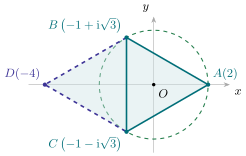
In the complex plane referred to a direct orthonormal coordinate system , consider the points , and with respective affixes:
1. Compute the modulus and an argument of , and . Deduce that the points , and lie on the same circle with center , whose radius is to be specified.
2. Compute the quotient in algebraic form, then in exponential form. Deduce the exact nature of the triangle and check that the origin is its centroid.
3. Determine the affix of the point such that the quadrilateral is a rhombus, and compute the exact area of this rhombus.
Solution
1. Let us determine the exponential forms of the three affixes:
- , so and ;
- and ;
- , so and . We have : the three points , and lie on the circle with center and radius .
2. Let us compute the affixes of the vectors and : The quotient is then: We deduce: The triangle is therefore a direct equilateral triangle, with side . Moreover, the affix of the centroid of is: The origin is indeed the centroid (and the center of the circumscribed circle) of the equilateral triangle .
3. Since the triangle is equilateral, we already have . The quadrilateral is therefore a rhombus if and only if it is a parallelogram, that is, if , that is: The area of the rhombus is twice the area of the equilateral triangle with side :
Similar exercises
- Collinearity, orthogonality and concyclicity of four points solved
- Loci defined by moduli and arguments solved
- Study of a homographic transformation and loci solved
- The complex inversion : images of lines and circles solved
- Equilateral triangles constructed on two sides of a triangle solved
The course of the chapter · All the exercises of the chapter