Mathematics (Grade 12 General Sciences, Lebanon) · Chapter 3 · Tutorial exercise
Study of convexity, points of inflection and crossing of the tangent
Second derivatives, convexity and L'Hôpital's rule · B. Second derivative, convexity, concavity and points of inflection · level 2
Statement
Let be the polynomial function of degree defined on by: Let denote its representative curve in an orthogonal coordinate system.
- Compute and for every .
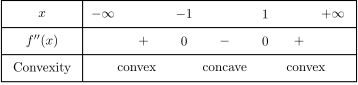
- Study the sign of on . Deduce the intervals on which the function is convex or concave, and determine the coordinates of the points of inflection and of the curve .
- Determine an equation of the tangent to at the point of inflection with abscissa , then, writing this equation , study the sign of the difference to check algebraically that the curve crosses its tangent at .
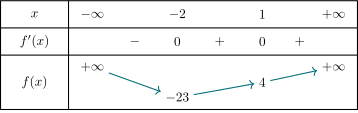
- Deduce from the previous questions the direction of variation of , then the sign of on (note that is a root of ), and draw up the complete table of variations of .
Solution
1. First derivative and second derivative. The polynomial function is twice differentiable on and, for every :
2. Convexity, concavity and points of inflection. The second derivative vanishes and changes sign at and at :
- On and on , we have , so the function is convex on and on .
- On , we have , so the function is concave on .
- Since vanishes and changes sign at and at , the curve has exactly two points of inflection: (since and ).
3. Tangent at the point of inflection and relative position. We have , whereas at , . Let us compute the two tangents at the points of inflection:
- At , we have , so the tangent has equation: Let us study the difference . Since is the tangent at a point of inflection at , divides ! Let us check it: . Thus: Near (where ), the factor vanishes and changes sign: is positive to the left of and negative to the right of (on ). The curve therefore crosses its tangent at .
- At , we have both and : the point is a point of inflection with a horizontal tangent , and: which also changes sign at : the curve also crosses its tangent at .
4. Sign of and variations of . By question 2, is nonnegative on and on , and nonpositive on : the function is increasing on , decreasing on and increasing on . On , its minimum is , so ; on , increases from to and therefore vanishes exactly once. To find this zero, let us factor by (since and ): Since (vanishing at without changing sign), the sign of is that of :
- on ;
- and (absolute minimum of on );
- on (vanishing only at and ). The function is therefore strictly decreasing on and strictly increasing on .
What the exercise establishes.
- Remember that at a point of inflection with abscissa of a polynomial function, the difference can be factored by , which explains algebraically why the curve crosses the tangent.
- Illustrate that a first derivative can vanish without an extremum ( with a change of sign of at : point of inflection with a horizontal tangent).
Similar exercises
- L'Hôpital's rule: forms , iterations and transformation of and solved
- Successive derivatives and proof by induction solved
- Convexity of a rational function and study of the points of inflection solved
- Position with respect to tangents and chords: classic inequalities solved
- L'Hôpital's rule with parameters and determination of constants solved
The course of the chapter · All the exercises of the chapter