Physics (Grade 10, Lebanon) · Chapter 1 · Tutorial exercise
Cascades of contacts between four identical conducting spheres
Electrostatics · B. Quantization and conservation of electric charge · level 2
Statement
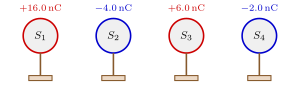
Four identical metal spheres , , and , mounted on insulating stands, initially carry the electric charges:
- Calculate the total electric charge of the system formed by the four spheres.
- Protocol 1 (contacts in pairs then crossing):
- is brought into contact with on the one hand, and with on the other hand, simultaneously, then they are separated. Calculate the intermediate charges , , and .
- is then brought into contact with , then they are separated. Calculate the final charges of the four spheres and check the conservation of the total charge.
- Protocol 2 (simultaneous contact of the four spheres): If the four spheres were brought into contact with one another simultaneously before being separated, what would be the final charge of each of them?
Solution
- The total charge of the isolated system of the four spheres is the algebraic sum of the initial charges: 2.
- First step: Contact between and : Contact between and :
- Second step: (which carries ) and (which carries ) are brought into contact, while and are not touched: The final charges are therefore: We check that the sum of the final charges is indeed .
- During a simultaneous contact of four strictly identical conducting spheres, the total charge is shared by symmetry into four equal parts:
What the exercise establishes: Methodically follow the evolution of the charges during a sequence of successive contacts and use the conservation of the total charge as a systematic check of the calculations.
Similar exercises
- Electrification of an electroscope by contact and by induction with grounding solved
- Quantization of charge and sorting of physically possible values solved
- Electron balance and sharing of charge between two conducting spheres solved
- Electrical neutrality of matter and ionic charges in a crystal solved
- Principle of an electrostatic shuttle and iterative sharing of charges solved
The course of the chapter · All the exercises of the chapter