Physics (Grade 10, Lebanon) · Chapter 1 · Direct application of the course
Diagnosis using an electroscope
Electrostatics · level 2
Statement
A gold-leaf electroscope is initially neutral.
- A PVC rod previously rubbed with fur is brought close to the plate, without touching it. Specify the sign of the charge of the PVC and describe what is observed at the leaves of the electroscope, specifying the sign of the charges on the plate and on the leaves.
- While keeping the PVC rod still near the plate, an experimenter briefly touches the plate with a finger, then removes the finger and finally moves the PVC rod away. Explain why the electroscope remains charged and determine the sign of its final charge.
Solution
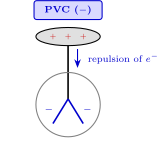
- The PVC rod rubbed with fur carries a negative charge (). When it is brought close to the plate without touching it, it repels by induction the free electrons of the plate toward the bottom of the rod and into the gold leaves:
- The plate has a deficit of electrons and becomes positively charged ().
- The two gold leaves have an excess of electrons and become negatively charged (). Carrying charges of the same sign, the two leaves repel each other and spread apart.
- When the experimenter touches the plate with a finger (grounding through the human body) while the negative PVC rod is kept nearby:
- The positive charges of the plate remain held (trapped) by the attraction of the very close negative PVC rod.
- On the other hand, the excess free electrons that had been repelled into the leaves flow to the Earth through the operator's finger: the leaves fall back.
- When the finger is removed first (the electroscope becomes isolated again with an overall deficit of electrons), and the PVC rod is then moved away, the deficit of electrons spreads over the whole metal assembly (plate, rod and leaves). The electroscope therefore remains durably positively charged () and its leaves spread apart again: this is charging by induction and grounding.
Similar exercises
- Principle of an electrostatic shuttle and iterative sharing of charges solved
- Electrification of an ebonite rod by friction solved
- Sharing of charges between two conducting spheres solved
- Successive contacts between three identical spheres solved
- Charge of a monatomic ion and of a sample solved
The course of the chapter · All the exercises of the chapter