Physics (Grade 10, Lebanon) · Chapter 1 · Tutorial exercise
Electrification of an electroscope by contact and by induction with grounding
Electrostatics · A. Modes of electrification, electroscope and electronic interpretation · level 2
Statement
A gold-leaf electroscope, initially neutral, has an upper metal plate connected by a conducting rod (insulated from the case by a plastic stopper) to two very light gold leaves and .
- Experiment A: An ebonite rod previously rubbed with a cat skin is brought close to plate , without touching it. a) Specify the sign of the charge of the ebonite and explain, based on the motion of the free electrons in the electroscope, why leaves and spread apart. b) What happens if the ebonite rod is then moved away?
- Experiment B: Plate is now touched with the charged ebonite rod, then the rod is moved away. a) What is the sign of the charge acquired by the electroscope? Do the leaves fall back after the rod is moved away? b) A glass rod rubbed with silk is then brought close to the plate of this electroscope (without touching it). Does the separation of the leaves increase or decrease? Justify.
- Experiment C: The electroscope is completely discharged to bring it back to the neutral state. The positively charged glass rod () is again brought close to plate , without touching it. While keeping the glass rod still near , plate is briefly touched with a finger, the finger is removed, then the glass rod is moved away. Describe and explain the state of the leaves at each of these steps and give the sign of the final charge of the electroscope.
Solution
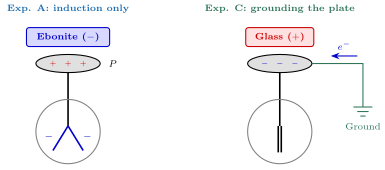
- Experiment A (simple induction): a) The ebonite rubbed with a cat skin has gained electrons and carries a negative charge (). When it is brought close to plate without touching it, it repels at a distance (by induction) part of the free electrons of the metal plate toward the bottom of the rod and into the gold leaves and . Plate therefore becomes positively charged (deficit of electrons, ) while the two leaves and become negatively charged (excess of electrons, ). Carrying charges of the same sign, the two leaves repel each other and spread apart. b) Since no electron has left the electroscope, its total charge has remained zero (). As soon as the ebonite is moved away, the free electrons move back up to spread out uniformly and the leaves fall back vertically.
- Experiment B (electrification by contact and sign test): a) During contact with the ebonite (), excess electrons pass from the ebonite onto the plate and spread over the whole metal assembly (plate, rod and leaves). The electroscope acquires a permanent negative charge (): after the rod is moved away, the leaves keep their excess of electrons and remain apart. b) When the positively charged glass rod () is then brought close to the plate of the negative electroscope, the positive rod attracts toward plate part of the excess free electrons that were in leaves and . The negative charge present in the leaves therefore decreases in absolute value: the repulsion between and weakens and the separation of the leaves decreases.
- Experiment C (permanent charging by induction and grounding):
- Approach of the glass rod (): the free electrons are attracted toward the plate (), leaving a deficit of electrons in the leaves (). The leaves spread apart.
- Finger touching the plate (grounding) in the presence of the glass rod: the electrons accumulated on plate remain held by the attraction of the very close glass rod. On the other hand, the Earth (via the experimenter's body) supplies free electrons that fill the deficit of electrons of leaves and : the leaves become neutral again () and fall back.
- Removal of the finger then removal of the glass rod: once the finger is removed, the metal assembly is isolated again and has, overall, the additional electrons held on the plate. When the glass rod is moved away, this excess of electrons spreads over the plate, the rod and the leaves: the electroscope is now permanently negatively charged (sign opposite to that of the inducing rod) and the leaves spread apart again.
What the exercise establishes: Master the microscopic analysis of the electroscope and understand why electrification by contact gives a charge of the same sign as the inducing body, whereas electrification by induction followed by grounding gives a charge of the opposite sign.
Similar exercises
- Series of interactions between pendulums and identification of the sign of the charges solved
- Quantization of charge and sorting of physically possible values solved
- Electron balance and sharing of charge between two conducting spheres solved
- Cascades of contacts between four identical conducting spheres solved
- Electrical neutrality of matter and ionic charges in a crystal solved
The course of the chapter · All the exercises of the chapter