Physics (Grade 10, Lebanon) · Chapter 1 · Tutorial exercise
Series of interactions between pendulums and identification of the sign of the charges
Electrostatics · A. Modes of electrification, electroscope and electronic interpretation · level 1 (application)
Statement
In the laboratory, we have five small light electrostatic pendulums , , , and , as well as a glass rod that is vigorously rubbed with a dry wool cloth. The following tests are carried out in succession, without ever causing contact:
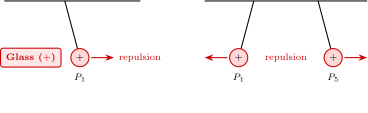
- The rubbed glass rod repels pendulum and attracts pendulum .
- Pendulum attracts pendulums , and , but repels pendulum .
- Pendulums and repel each other, while pendulum attracts pendulum .
Determine, rigorously justifying each step, the electric state (positively charged, negatively charged or electrically neutral) of each of the five pendulums to , and specify for the charged pendulums whether they have an excess or a deficit of electrons.
Solution
- Key reminder: Two bodies repel each other if and only if they carry electric charges of the same sign. On the other hand, an attraction between two bodies can have two causes: either they carry charges of opposite signs, or one is charged and the other is electrically neutral (attraction by electrostatic induction). Repulsion is therefore the only absolute criterion proving that a pendulum is charged and making it possible to identify its sign.
- Sign of the glass rod: By convention, glass rubbed with a wool cloth loses electrons and acquires a positive electric charge ().
- Study of and : The glass rod () repels , so necessarily carries a positive charge (). Moreover, () repels , so is also positively charged (). Microscopically, and both have a deficit of electrons.
- Study of and : According to observation 3, and repel each other: they are therefore both charged and carry charges of the same sign (neither of them is neutral). Now, according to observation 2, () attracts and . Since and are not neutral, they must carry a charge of the sign opposite to that of , that is, a negative charge ( and ). Microscopically, and have an excess of electrons.
- Study of : Pendulum is attracted both by (which is positively charged, ) and by (which is negatively charged, ). A body attracted by a positive charge as well as by a negative charge is necessarily electrically neutral (): it undergoes a temporary electrification by induction when each charged pendulum approaches.
What the exercise establishes: Distinguish the conclusive character of a repulsion (which guarantees that the two bodies are charged with the same sign) from the ambiguity of an attraction (opposite signs or neutral body polarized by induction).
Similar exercises
- Electrification of an electroscope by contact and by induction with grounding solved
- Quantization of charge and sorting of physically possible values solved
- Electron balance and sharing of charge between two conducting spheres solved
- Cascades of contacts between four identical conducting spheres solved
- Electrical neutrality of matter and ionic charges in a crystal solved
The course of the chapter · All the exercises of the chapter