Physics (Grade 10, Lebanon) · Chapter 1 · Direct application of the course
Sharing of charges between two conducting spheres
Electrostatics · level 1 (application)
Statement
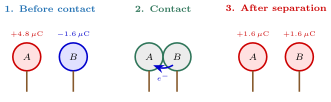
Two small identical metal spheres and , mounted on insulating supports, carry the charges and respectively.
- What is the nature (attractive or repulsive) of the electrostatic interaction between and before any contact?
- The two spheres are brought into contact, then separated. Determine the final charge of each sphere.
- In which direction (from to or from to ) did the electrons move during the contact? Calculate the number of electrons transferred from one sphere to the other.
Solution
- Initially, and : the two spheres carry electric charges of opposite signs, so they attract each other.
- The two conducting spheres being identical and the system being isolated, the total charge is conserved and is shared equally between the two spheres:
After separation, the two spheres each carry the positive charge and repel each other.
- Sphere went from an initial charge to a final charge : its charge increased by . It therefore lost electrons to sphere . The free electrons moved from sphere to sphere .
The number of electrons transferred from to is:
Similar exercises
- Principle of an electrostatic shuttle and iterative sharing of charges solved
- Electrification of an ebonite rod by friction solved
- Successive contacts between three identical spheres solved
- Diagnosis using an electroscope solved
- Charge of a monatomic ion and of a sample solved
The course of the chapter · All the exercises of the chapter