Physics (Grade 10, Lebanon) · Chapter 12 · Tutorial exercise
Successive refraction of a mechanical wave on a submerged triangular plate
Reflection and refraction of waves · B. Refraction and diffraction of mechanical waves · level 3 (hard)
Statement
At the bottom of a ripple tank where the water depth is (region , speed ), a Plexiglas plate in the shape of a right triangle (, , ) is submerged horizontally. Above this triangular plate (region ), the thickness of water is smaller and the speed of the waves is only . A vibrator of frequency fitted with a flat bar sends into region a train of straight waves whose wavefronts are parallel to the side of the triangle.
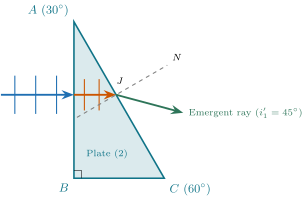
- Calculate the wavelengths in the deep water (region ) and above the triangular plate (region ).
- Study of the entry into region through the side : a) What is the angle of incidence of the waves on the boundary ? b) Deduce the angle of refraction when crossing . Are the wavefronts deviated on entering above the plate? What nevertheless changes when crossing ?
- Study of the exit from region into region through the hypotenuse : a) Using the geometry of the triangle (), determine the angle of incidence at which the wave rays (which remained perpendicular to in region ) reach the boundary . b) Apply the Snell-Descartes law to the crossing of (passage from region of speed to region of speed ) to calculate the angle of refraction at the exit into the deep water. c) Calculate the total deviation undergone by the direction of propagation of the waves after the complete crossing of the triangular plate.
Solution
- Let us calculate the wavelengths in the two regions for :
- a) Since the incident wavefronts are parallel to the side , the incident wave rays (perpendicular to the wavefronts) are perpendicular to , hence coincide with the normal to : this is normal incidence, that is: b) According to the Snell-Descartes law , since , we have . The waves enter above the plate without any deviation (the wavefronts remain parallel to ), but their speed decreases from to and their wavelength shortens from to (the crests come closer together).
- a) In region , the wavefronts are still parallel to the side . Now the hypotenuse makes an angle with the side . The angle formed by the wavefronts of region with the exit boundary (which is equal to the angle of incidence between the wave rays and the normal to ) is therefore: b) At the exit through , the wave passes from medium (speed ) into medium (speed ). The Snell-Descartes law is written: With (), we obtain: Since the wave passes back into the faster deep water (), the emergent wave ray bends away from the normal to () and recovers its initial wavelength . c) Since the ray underwent no deviation on the first face (), the total deviation occurs entirely on the second face :
What the exercise establishes: Study the complete crossing of an acoustic or hydrodynamic prism by combining normal incidence (), the geometry of the triangle () and the refraction at the exit ().
Similar exercises
- Reflection of a circular wave on a plane wall and virtual source solved
- Echo from a wall and locating an obstacle by reflection solved
- Refraction of a straight wave when crossing a submerged step solved
- Refraction of an ultrasonic wave between water and a biological tissue solved
- Diffraction of mechanical waves on the surface of water and of sound waves solved
The course of the chapter · All the exercises of the chapter