Physics (Grade 10, Lebanon) · Chapter 7 · Tutorial exercise
Identifying the nature of a rectilinear motion from the vectors and
Description of motion · B. Instantaneous velocity, acceleration and vector character in rectilinear motion · level 2
Statement
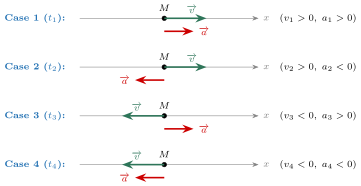
A point object moves along a horizontal axis oriented from left to right. At four different instants , , and , the velocity vector and the acceleration vector of the object have been represented:
- Case 1 (instant ): points to the right and points to the right;
- Case 2 (instant ): points to the right and points to the left;
- Case 3 (instant ): points to the left and points to the right;
- Case 4 (instant ): points to the left and points to the left.
- In each of the four cases, state in which direction the object is moving, compare the directions of the vectors and , and deduce whether the motion is accelerated or decelerated (retarded).
- Answer True or False to the following three statements, correcting those that are false: a) “In a rectilinear motion, the velocity vector is sometimes in the direction opposite to the motion.” b) “In a rectilinear motion, the velocity vector always has the same direction as the acceleration vector.” c) “A particle in rectilinear motion can have a constant velocity and a nonzero acceleration.”
Solution
- Let us recall the fundamental rule for a rectilinear motion: the direction of the motion is always given by the velocity vector . If and have the same direction, the velocity increases (accelerated motion); if and are in opposite directions, the velocity decreases (decelerated motion).
- Case 1 (): the object moves to the right; and are both directed to the right (same direction) accelerated rectilinear motion.
- Case 2 (): the object moves to the right; (right) and (left) are in opposite directions decelerated rectilinear motion.
- Case 3 (): the object moves to the left; (left) and (right) are in opposite directions decelerated rectilinear motion.
- Case 4 (): the object moves to the left; and are both directed to the left (same direction) accelerated rectilinear motion.
- True or False: a) False. By definition, the direction of the instantaneous velocity vector is always that of the motion at the instant considered. b) False. In a rectilinear motion, and have the same direction only when the motion is accelerated; they are in opposite directions when the motion is decelerated. c) False. In a rectilinear motion, if the velocity remains constant (), the change in velocity is zero over any time interval, so the acceleration is necessarily zero.
What the exercise establishes: Be able to recognize immediately on a diagram whether a rectilinear motion is accelerated or decelerated by comparing only the directions of the arrows and .
Similar exercises
- Average speed over a rectilinear trip with a stop and unit conversions solved
- Time of inattention at the wheel and staggered arrival of two cars solved
- Representation of the velocity vector, calculation of average acceleration and nature of the motion solved
- Using a full-scale recording on an inclined air table solved
- Synthesis problem: air puck on an inclined table followed by a horizontal plane (recording at the scale 1/2) solved
The course of the chapter · All the exercises of the chapter