Physics (Grade 10, Lebanon) · Chapter 7 · Direct application of the course
Using a rectilinear recording on an air table
Description of motion · level 1 (application)
Statement
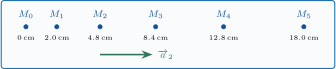
An air puck slides in a straight line along an oriented axis on an inclined air table. The successive positions are recorded at regular time intervals . The actual abscissas measured from () are:
- Calculate the values of the instantaneous velocities , , and at the points , , and . Give the characteristics of the velocity vector and calculate the length of the arrow that represents it at the scale .
- Calculate the values of the acceleration (at the point ) and (at the point ). Give the characteristics of the acceleration vector and conclude on the nature of the motion of the puck.
Solution
- The bracketing time is . By the formula (with the abscissas converted to meters):
- ;
- ;
- ;
- .
The velocity vector has the point as its origin, the line of the motion as its line of action, the direction of the motion (direction of ) as its direction and as its magnitude. At the scale , it is represented by an arrow of length .
- By the bracketing formula for the acceleration :
The velocity increases over time and the acceleration keeps a constant value : the acceleration vector lies along the line of the motion, is directed in the same direction as the velocity vector and has magnitude . The motion of the puck is uniformly accelerated rectilinear.
Similar exercises
- Synthesis problem: air puck on an inclined table followed by a horizontal plane (recording at the scale 1/2) solved
- Position vector and change of origin on a rectilinear axis solved
- Average speed over two consecutive sections solved
- Average acceleration during a start then a braking solved
- Reduced-scale recording of a moving object that slows down solved
The course of the chapter · All the exercises of the chapter