Physics (Grade 10, Lebanon) · Chapter 9 · Tutorial exercise
Deflection pulley and resultant of two equal tensions
Force and resultant of forces · A. Geometric and trigonometric composition of two concurrent forces · level 2
Statement
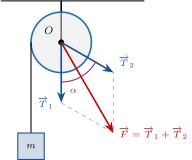
A flexible, inextensible cable of negligible mass passes without friction in the groove of a pulley with fixed axis . One of the ends of the cable supports vertically a load of mass , which creates in the whole cable a uniform tension of magnitude (with ). The strand of the cable is vertical (directed downward), while the strand pulled by a worker makes an angle with the downward vertical .
- Justify that the cable exerts on the pulley two concurrent forces and of the same magnitude . What is the line of action of their resultant ?
- Express the magnitude of the resultant exerted by the cable on the axis of the pulley as a function of and , then calculate for: a) (the two strands are vertical and downward); b) ; c) (the strand is horizontal); d) .
- The hook that fixes the pulley to the ceiling can withstand at most a force of magnitude . What is the minimum value of the angle below which the hook is likely to give way?
Solution
- Since the cable is inextensible and of negligible mass on a frictionless pulley, the tension has the same magnitude in the two strands. The pulley is therefore subjected to two forces (along ) and (along ) of the same magnitude . The parallelogram constructed on and is a rhombus: the resultant lies along the internal bisector of the angle , making an angle with the downward vertical.
- By the rhombus formula (or by ):
- a) : .
- b) : .
- c) : .
- d) : .
- For the hook to hold, we need : Since the cosine function is decreasing on , we obtain , that is, .
What the exercise establishes: Use the symmetry of the rhombus ( and direction along the bisector) when two concurrent forces have the same magnitude.
Similar exercises
- Resultant of two forces according to the angle between them solved
- Finding a component when the resultant is known solved
- Resolution of a pulling force and normal action of the ground solved
- Resolution of the forces on an inclined plane solved
- Resultant of three concurrent forces by the method of projections solved
The course of the chapter · All the exercises of the chapter