Physics (Grade 10, Lebanon) · Chapter 9 · Tutorial exercise
Resultant of two forces according to the angle between them
Force and resultant of forces · A. Geometric and trigonometric composition of two concurrent forces · level 1 (application)
Statement
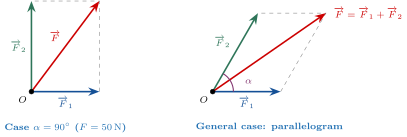
A metal ring of negligible size, modeled as a material point , is subjected to two concurrent forces and of respective magnitudes and . We denote by the angle formed by the directions of the two forces and by their resultant.
- Calculate the magnitude of the resultant and the angle in the three special configurations: a) ; b) ; c) .
- Calculate the magnitude and the angle when the angle between the two forces is: a) ; b) .
- Using a third dynamometer, a resultant of magnitude is measured experimentally. Determine the angle that the two forces and then make.
Solution
- Let us study the three special configurations:
- a) (collinear forces in the same direction):
- b) (collinear forces in opposite directions): Since , the resultant is directed in the direction of , hence opposite to : .
- c) (perpendicular forces): according to the Pythagorean theorem: and .
- Let us apply the general cosine formula and :
- a) For (, ):
- b) For (, ):
- From , we isolate for : We deduce .
What the exercise establishes: Apply without hesitation the law of cosines for an acute angle () as well as for an obtuse angle ().
Similar exercises
- Deflection pulley and resultant of two equal tensions solved
- Finding a component when the resultant is known solved
- Resolution of a pulling force and normal action of the ground solved
- Resolution of the forces on an inclined plane solved
- Resultant of three concurrent forces by the method of projections solved
The course of the chapter · All the exercises of the chapter