Physics (Grade 10, Lebanon) · Chapter 9 · Direct application of the course
Towing a barge with two symmetric cables
Force and resultant of forces · level 2
Statement
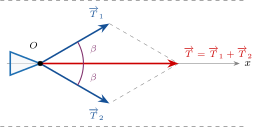
A barge is pulled along a straight canal of axis by two tugboats connected to the bow by two cables exerting tensions and of the same magnitude , arranged symmetrically on either side of the axis with an angle each relative to .
- What is the total angle between and ? Specify without calculation the line of action and the direction of the resultant , then calculate its magnitude in two different ways (by the rhombus formula then by projection onto and ).
- What should the common value of the tension of each cable be for the resultant to have the same magnitude if the cables were spread at relative to ? Conclude on the advantage of using long cables (small angle ).
Solution
- The angle between and is . Since , the parallelogram is a rhombus: the resultant lies along the bisector of , that is, along the axis of the canal, in the direction of travel.
- Method 1 (rhombus formula):
- Method 2 (projection onto with ):
The transverse components and cancel exactly, and .
- To obtain the same resultant pulling force with , we need:
The larger the angle , the higher the tension in each cable must be to produce the same useful resultant along ; long cables are therefore used to reduce and put less strain on the cables.
Similar exercises
- Steering a cargo ship in a harbor channel solved
- Resultant of two forces for different angles solved
- Reaction of a rough support and angle of friction solved
- Resultant of three concurrent forces by analytical projection solved
- Inventory and resultant of the forces on an inclined plane solved
The course of the chapter · All the exercises of the chapter