Physics (Grade 11, Lebanon) · Chapter 13 · Tutorial exercise
Solenoid with its axis oblique to a uniform magnetic field
Magnetic field created by an electric current · B. Circular loops, flat coils and solenoids · level 2
Statement
A long solenoid of length with turns has its horizontal axis making an angle with the direction of an external uniform horizontal magnetic field of magnitude (see figure).
1) Calculate the magnitude of the magnetic field created by the solenoid at its center when it carries a current .
2) By projecting the vectors and onto an orthonormal coordinate system where is a unit vector collinear with and in the same sense (or by using the law of cosines), calculate the magnitude of the resultant magnetic field at as well as the angle it makes with .
3) What current must flow in the solenoid for the resultant field to be perpendicular to the vector ?
4) Limiting case. Is there a value of the current that cancels the total field when ? What orientation should be given to the solenoid to be able to cancel ?
Solution
The strategy. When two magnetic fields are neither collinear nor perpendicular, they are projected onto two perpendicular axes (along ) and (perpendicular to ): and .
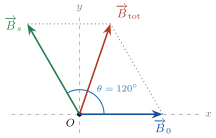
1) Magnitude for . With :
2) Components, magnitude of and angle . With and : We deduce:
3) Current making perpendicular to . The vector is perpendicular to (axis ) if and only if its -component is zero: We get the current :
4) Limiting case: impossibility of cancelling for . To cancel a vector, its two components and must be zero simultaneously. Now for , , so is zero only if (in which case ). To be able to cancel , the axis of the solenoid must necessarily be oriented along the same direction as and in the opposite sense, that is .
What the exercise establishes: Projecting a vector sum onto a Cartesian coordinate system easily solves all problems where the magnetic sources make any angle with each other.
Similar exercises
- Superposition of the fields created by two parallel wires at any point of the plane solved
- Circular loop, flat coil and compensation of the field of a tangent straight wire solved
- Solenoid with several layers of close-wound turns and use of the straight line solved
- The tangent-galvanometer method: graphical determination of solved
- Problem: complete study of a magnetic compensator in the laboratory solved
The course of the chapter · All the exercises of the chapter