Physics (Grade 11, Lebanon) · Chapter 13 · Tutorial exercise
Superposition of the fields created by two parallel wires at any point of the plane
Magnetic field created by an electric current · A. Infinite straight conductors and Œrsted's experiment · level 2
Statement
Two long parallel straight conducting wires and , perpendicular to the plane of the figure, cut this plane at two points and a distance apart. The wire at carries a current coming out () of value and the wire at a current going in () of value .
1) Calculate the magnitudes and of the fields created by and at the midpoint of the segment , then determine the direction, the sense and the magnitude of the resultant field .
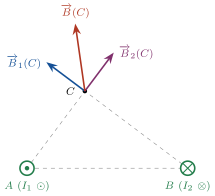
2) Consider a point of the plane such that the triangle is right-angled at with and . Check the geometric consistency of these lengths and calculate the magnitudes and of the fields created at by each of the two wires.
3) Show geometrically that the vectors and are perpendicular to each other at the point , then calculate the magnitude of the resultant magnetic field .
4) Limiting case. If the two currents are in opposite directions ( coming out and going in with ), can there be a point of zero field between and ? On which side along the line is the only point where the resultant field vanishes, and at what distance from ?
Solution
The strategy. At each point studied ( then ), we draw the radii from and from , then the vectors and perpendicular to these respective radii and oriented by the right-hand rule (counterclockwise around , clockwise around ).
1) Resultant field at the midpoint of . At the point , .
- Around (), the field lines turn counterclockwise: to the right of (at ), is perpendicular to and points upward.
- Around (), the field lines turn clockwise: to the left of (at ), is also perpendicular to and points upward. The two vectors therefore have the same direction and the same sense:
2) Magnitudes of the fields at the point . We check that : by the converse of the Pythagorean theorem, the triangle is indeed right-angled at . At ( and ):
3) Perpendicularity of and and resultant magnitude. By definition of the field of a straight wire, is perpendicular to the radius and is perpendicular to the radius . Now the lines and are perpendicular to each other (triangle right-angled at ): two vectors respectively perpendicular to two perpendicular lines are themselves perpendicular (). Hence:
4) Limiting case: point of zero field for two currents in opposite directions. Between and , and both point upward: their sum can never vanish on . On the other hand, outside the segment , the two fields point in opposite directions ( downward and upward to the left of ). Since , the point where the field vanishes must be closer to the weaker current , hence to the left of at the distance (and ):
What the exercise establishes: For two parallel wires carrying currents in opposite directions, the fields add up between the two wires and subtract outside the two wires (the reverse of two currents in the same direction).
Similar exercises
- Quantitative Œrsted experiment: deflection of a compass under a straight wire solved
- Circular loop, flat coil and compensation of the field of a tangent straight wire solved
- Solenoid with several layers of close-wound turns and use of the straight line solved
- The tangent-galvanometer method: graphical determination of solved
- Solenoid with its axis oblique to a uniform magnetic field solved
The course of the chapter · All the exercises of the chapter