Physics (Grade 11, Lebanon) · Chapter 17 · Tutorial exercise
Optical bench: how the real image changes as the object is brought closer to a converging lens
Thin lenses and optical systems · A. Converging lenses, focal points, vergence and formation of real images · level 2
Statement
On a graduated optical bench, a thin converging lens of focal length is fixed at . A vertical luminous object of height ( on the optical axis) is moved in front of the lens and given three positions in turn:
- Position 1: the object is placed in front of the lens ();
- Position 2: the object is placed in front of the lens ();
- Position 3: the object is placed in front of the lens ().
1) Calculate the vergence of the lens in diopters.
2) For each of the three positions , and of the object, calculate the algebraic position of the image, the magnification and the algebraic size of the image captured on the screen.
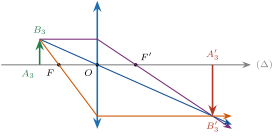
3) Draw the geometric construction of the three special rays for Position 3 (). How do the position of the screen and the size of the real image change as the object approaches the object focal point coming from the left?
4) Limiting case. What happens on the optical bench when the object is brought exactly to the principal object focal point ()? Why is this setup used in car headlights or theater spotlights?
Solution
The strategy. We write the conjugation relation in the explicit form (with ), which allows a quick calculation in centimeters, then and .
1) Vergence of the lens. With :
2) Positions, magnifications and sizes of the three real images.
- Position 1 (, that is, ): The image is real, inverted and reduced by half (principle of the camera).
- Position 2 (, that is, ): The image is real, inverted, symmetric with respect to () and the same size as the object.
- Position 3 (, that is, ): The image is real, inverted and enlarged twice (principle of the cinema projector).
3) Geometric construction (Position 3) and change of the image. As the object approaches (), the real image moves away from the lens toward the right () and grows larger and larger ().
4) Limiting case: object placed at the principal object focal point (). When , the denominator vanishes: . The rays coming from the same point of the object emerge from the lens parallel to one another and the image is sent to infinity. By placing a light bulb exactly at the focal point of a converging lens, a long-range parallel cylindrical beam is obtained (headlight projector).
What the exercise establishes: For a converging lens with an object before (), the object and the real image always move in the same direction along the optical axis, and the boundary between a reduced image () and an enlarged image () lies at the distance .
Similar exercises
- Characterizing a set of lenses, focal points and the theorem of vergences solved
- Complete study of a botanist's magnifying glass solved
- Diverging lens: construction, calculations and comparison with a converging lens solved
- Study of a myopic eye and determination of the corrective lens solved
- Comparing hyperopia and presbyopia and calculating converging lenses solved
The course of the chapter · All the exercises of the chapter