Physics (Grade 11, Lebanon) · Chapter 8 · Tutorial exercise
Atwood machine with a massive pulley: Newton's second law in translation and in rotation
Rotational dynamics and equilibrium of a solid · B. Statics of solids and rotational dynamics · level 2
Statement
An Atwood machine consists of a homogeneous pulley modeled as a solid disk of mass , radius and moment of inertia , free to turn without friction about its fixed horizontal axis passing through its center . An inextensible string of negligible mass runs in the groove of the pulley and carries at its two ends two point bodies of masses and (). During the motion, the string does not slip in the groove of the pulley. The system is released from rest at the instant . Take .
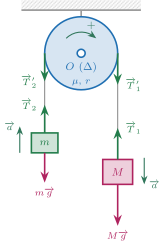
1) Apply Newton's second law successively to the mass (which moves down with the acceleration ) and to the mass (which moves up with the same acceleration ).
2) Apply Newton's second law for rotation about the axis to the pulley, considered as a homogeneous solid disk of moment of inertia , and relate the tensions and of the two strands of the string to the linear acceleration . Why must ?
3) Deduce the literal expressions, then the numerical values, of the linear acceleration of the two masses and of the angular acceleration of the pulley.
4) Express in terms of and , then calculate numerically, the tensions and of the two strands of the string, as well as the speed of the blocks and the number of revolutions made by the pulley at the instant .
Solution
The strategy. Since the pulley has a mass and a moment of inertia , setting it in accelerated rotation () requires a nonzero driving resultant moment , so that the tensions of the two strands on either side of the pulley are different (). On the other hand, since each strand has negligible mass, the tension is uniform along a given strand ( and ).
1) Newton's second law applied to and to . Since the string is inextensible, when moves down a distance , moves up the same distance , so at every instant the two blocks have the same speed and the same magnitude of acceleration :
- For the block , projecting onto a downward vertical axis:
- For the block , projecting onto an upward vertical axis:
2) Newton's second law applied to the pulley. The pulley is subjected to its weight (applied at ), to the reaction of the axle (applied at ), and to the tensions (on the right, of magnitude ) and (on the left, of magnitude ) exerted tangentially by the two strands of the string. Choosing as the positive direction of rotation that of the motion (downward on the right), the moments of and about are zero, and the fundamental relation is written: Since the string does not slip in the groove of the pulley, the tangential acceleration of a point on the rim is equal to the acceleration of the string: . With , we get: We therefore have as soon as and : it is the tension difference that provides the net couple accelerating the pulley.
3) Linear acceleration and angular acceleration . Adding the three equations side by side eliminates the tensions and : Numerical application with , , and : and the angular acceleration of the pulley () is:
4) Calculating the tensions and , and kinematics at . Substituting the expression of into and : (We check that .) At the instant , the speed of the blocks is and the angle swept by the pulley is , that is a number of revolutions .
What the exercise establishes: In any system of masses connected by a string that does not slip on a pulley of moment of inertia , the rotational inertia of the pulley adds to the masses in translation in the form of an additional effective mass in the denominator of the acceleration, and imposes unequal tensions on either side of the groove.
Similar exercises
- Calibrating a torsion wire and combining two wires solved
- Moment of inertia of a system of particles, of a half-hoop and of a flywheel with holes solved
- Equilibrium of a rod on a knife edge and of an inclined bar hinged on a wall solved
- Cylinder held in equilibrium on an inclined plane by a horizontal string solved
- Sizing the holding cable and the hinge of a harbor crane solved
The course of the chapter · All the exercises of the chapter