Physics (Grade 11, Lebanon) · Chapter 8 · Tutorial exercise
Equilibrium of a rod on a knife edge and of an inclined bar hinged on a wall
Rotational dynamics and equilibrium of a solid · B. Statics of solids and rotational dynamics · level 2
Statement
1) Horizontal rod held by a string and a knife edge. A homogeneous rod of mass and length is held horizontal in equilibrium: its end is attached to a vertical string stretched upward, while it rests on the horizontal edge of a knife. Express in terms of and the tension of the string and the magnitude of the reaction of the knife when the knife is placed:
- a) at the end of the rod;
- b) at a point of the segment such that ;
- c) at the midpoint of the rod ().
2) Inclined bar hinged on a wall. A homogeneous bar of length and mass is hinged without friction at its lower end about a horizontal axis fixed to a vertical wall. It is held in a position making an angle with the vertical wall (that is above the horizontal) by an inextensible cable attached at a point of the bar such that . The cable , fixed to the wall at above , is perpendicular to the bar . In addition, a body of mass is hung from the end . Take .
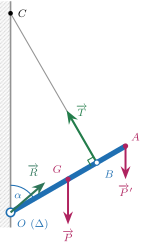
- a) Express, then calculate, the lever arms about of the weight of the bar, of the force exerted by the load at and of the tension of the cable at .
- b) Deduce the magnitude of the tension of the cable at equilibrium, as well as the components and the magnitude of the reaction of the axle at .
Solution
The strategy. For the horizontal rod resting on a knife edge at , we write the condition for rotational equilibrium about the axis passing through the point of support (which eliminates ), then the condition for vertical translational equilibrium . For the inclined bar, since the cable is perpendicular to the bar at , its lever arm is directly .
1) Horizontal rod held by a vertical string at and a knife edge. The rod is subjected to its weight at its midpoint (), to the upward vertical tension at and to the upward vertical reaction of the knife. Vertical translational equilibrium gives in every case.
- a) Knife at : the theorem of moments about the axis passing through is written , hence:
- b) Knife at such that : we then have and . The theorem of moments about the axis passing through gives , hence:
- c) Knife at the midpoint (): the weight acts directly on the knife (). The moment at gives and (the knife alone supports the whole rod at its center of gravity; the string is slack).
2) Inclined bar hinged on the wall.
- a) With , and to the vertical:
- b) The theorem of moments at () with and gives: In the coordinate system where is horizontal to the right and vertical upward, makes with toward the left (, ). The condition gives:
What the exercise establishes: Moving a knife-edge support toward the center of gravity of a beam reduces the lever arm of the weight about the support, which gradually transfers the whole load onto the support () and relieves the holding cable ().
Similar exercises
- Calibrating a torsion wire and combining two wires solved
- Moment of inertia of a system of particles, of a half-hoop and of a flywheel with holes solved
- Cylinder held in equilibrium on an inclined plane by a horizontal string solved
- Atwood machine with a massive pulley: Newton's second law in translation and in rotation solved
- Sizing the holding cable and the hinge of a harbor crane solved
The course of the chapter · All the exercises of the chapter