Physics (Grade 11, Lebanon) · Chapter 8 · Tutorial exercise
Sizing the holding cable and the hinge of a harbor crane
Rotational dynamics and equilibrium of a solid · B. Statics of solids and rotational dynamics · level 3 (hard)
Statement
A dock crane is modeled as a rigid non-homogeneous beam (the boom) of length and mass , hinged without friction at its lower end about a fixed horizontal axis . Since the boom is more massive toward its base, its center of mass lies on the segment at the distance from .
The boom is held inclined at an angle above the horizontal by a steel cable attached at a point of the boom such that . The cable makes an angle with the boom (the cable goes down from to its anchor point , located to the left of : it pulls the boom to the left and downward, at below the horizontal). A load of mass hangs from the upper end of the boom by a vertical cable. Take .
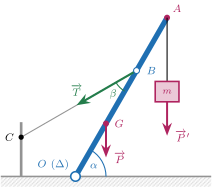
1) Lever arms and moment equation.
- a) Express in terms of , and the lever arms about the axis of the weight of the boom, of the vertical force exerted at and of the tension of the cable at .
- b) Establish the relation expressing the magnitude of the tension of the cable in terms of , and (replace and by the exact values of their trigonometric ratios).
2) Study for a nominal load .
- a) Calculate the magnitude of the tension of the cable .
- b) Determine the horizontal component and the vertical component of the reaction of the axle at on the boom, then calculate the magnitude and the angle that makes with the horizontal .
3) Maximum permissible load and moving the anchor point.
- a) The steel cable has a breaking tension and safety standards require never exceeding a maximum working tension . What is the maximum mass the crane can lift in this configuration?
- b) Without changing the cable () or the angle , the engineer moves the attachment point of the cable to the upper end of the boom (). What new maximum mass can the crane then lift safely?
Solution
The strategy. We treat the boom as the system in equilibrium: writing the theorem of moments at immediately eliminates the unknown reaction of the pivot and yields the affine law relating the tension of the cable to the mass lifted. We then project onto the horizontal/vertical coordinate system , taking care to identify the angle the cable makes with the horizontal ().
1) Lever arms and the law .
- a) The boom makes the angle with the horizontal:
- For the vertical weight applied at (), the lever arm is the horizontal projection of :
- For the vertical pull of the load at (), the lever arm is the horizontal projection of :
- For the tension applied at () and making the angle with the bar , the lever arm is:
- b) The theorem of moments about at () is written: Multiplying by , we obtain the very simple relation:
2) Calculations for .
- a) With , and :
- b) In the coordinate system where is horizontal to the right and vertical upward, the boom is inclined at and the cable pulls from toward at an angle below the direction of the boom, that is at an angle below the horizontal, toward the left: The first condition for equilibrium gives: (Since the cable also pulls downward with , the pivot must support both the total weight and the downward vertical component of the cable!) The magnitude of the reaction at is: and its inclination above satisfies , that is .
3) Maximum safe load and optimizing the anchor point.
- a) The condition is written:
- b) If the cable is attached at () at the same angle , its lever arm goes from to . The moment equation becomes: For , we obtain: Moving the anchor point from () to () increases the lifting capacity of the crane from to .
What the exercise establishes: In any hinged lifting structure, moving the attachment point of the holding cable back toward the end of the boom proportionally increases its lever arm , which reduces the tension of the cable as well as the compression exerted on the hinge .
Similar exercises
- Calibrating a torsion wire and combining two wires solved
- Moment of inertia of a system of particles, of a half-hoop and of a flywheel with holes solved
- Equilibrium of a rod on a knife edge and of an inclined bar hinged on a wall solved
- Cylinder held in equilibrium on an inclined plane by a horizontal string solved
- Atwood machine with a massive pulley: Newton's second law in translation and in rotation solved
The course of the chapter · All the exercises of the chapter