Physics (Grade 11, Lebanon) · Chapter 9 · Tutorial exercise
Systems of bodies coupled by a string and a pulley
Work, power and mechanical energy · A. Work, power and the kinetic energy theorem (KET) · level 2
Statement
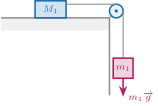
Part A — Two bodies coupled on a horizontal table with a pulley of negligible mass. Two bodies modeled as point particles of masses and are connected by an inextensible string of negligible mass passing over the groove of a pulley of negligible mass that turns without friction about its axis. The mass can slide without friction on a horizontal plane, while the mass hangs vertically. The system starting from rest, apply the kinetic energy theorem to determine the common speed acquired by the two masses after traveling a distance . Take .
Part B — Cart on an inclined plane driven by a cylinder and a counterweight. A cart of mass rests on a frictionless plane inclined at an angle to the horizontal. It is connected by an inextensible string of negligible mass, parallel to the inclined plane, to a body of mass hanging vertically. The string passes without slipping over the groove of a homogeneous cylindrical pulley of mass and radius (moment of inertia ), free to turn without friction about its horizontal axis . At , the system is released from rest.
1) Justify that the body goes down while the cart goes up the inclined plane, and express, at any instant, the total kinetic energy of the system in terms of and the common speed of the two blocks.
2) When the body has gone down a height , express the change in altitude of and apply the kinetic energy theorem to the complete system to calculate the speed acquired by the blocks.
3) By applying the kinetic energy theorem to the cart alone on the one hand, then to the body alone on the other, determine the tensions and of the two strands of the string and explain why .
Solution
The strategy. By first choosing the overall system with an inextensible string, the sum of the works of the internal tensions at the two ends of each strand of string is zero: a single energy equation directly gives the speed . We then isolate , then , to obtain the tensions and .
Part A — Two masses on a horizontal table with an ideal pulley. Since the string is inextensible, the two masses and have the same speed at every instant and travel the same distance . For the overall system , the weight and the normal reaction of the horizontal plane are perpendicular to the horizontal displacement of (), the works of the internal tensions of the string cancel out (), and only the weight of the hanging mass does driving work . The kinetic energy theorem between the initial rest and the end of the distance is written:
Part B — Inclined plane, massive cylinder and counterweight. 1) Direction of motion and total kinetic energy. The weight of is , greater than the tangential component of the weight of , which is : the block therefore goes down, pulling up the inclined plane. Since the string neither stretches nor slips on the pulley, when and have the speed , the pulley turns at the angular velocity . The total kinetic energy of the system is: With , and , the effective mass of the system is , that is .
2) Speed after a displacement . When goes down vertically by , the cart travels the distance along the inclined plane and therefore rises by the vertical height . The kinetic energy theorem applied to the overall system (the works of the internal tensions cancelling in pairs) is written: Numerically:
3) Tensions and of the two strands of the string.
- Let us apply the KET to the cart alone over the displacement :
- Let us apply the KET to the body alone over the descent : The tensions and are different because the pulley has a nonzero mass (): a nonzero resultant moment is needed to set the pulley in accelerated rotation.
What the exercise establishes: In a system of solids connected by an inextensible string passing over a pulley of moment of inertia , the pulley simply adds an equivalent mass to the translational inertia of the system.
Similar exercises
- Accounting for works, driving power and emergency braking of a truck solved
- Toppling of a vertical bar and compound pendulum solved
- Simple pendulum: speed, maximum tension of the string and breaking at the lowest point solved
- A skier leaving the top of a hemispherical mound (igloo) solved
- A puck going back and forth between a rough inclined plane and a smooth ramp solved
The course of the chapter · All the exercises of the chapter