The United Kingdom: institutions, politics, economy and society
Cours · anglais LV A et LV B (prépas ECG et ECT), chapitre 11 · prépas ECG et ECT, 1re et 2e années · le début du chapitre, la suite sur Adloun
The United Kingdom is the country that examiners expect you to know best, and the one about which candidates write the most clichés. It is neither a sleepy monarchy nor a country that ``left Europe'' in 2016 and stopped there. It is a parliamentary democracy without a written constitution, a union of four nations with very different politics, an economy that combines one of the world's great financial centres with deep regional inequality, and a society that has been reshaped by immigration and is still arguing about class.
This chapter gives you the facts and the vocabulary you need to use the UK in an essay or a summary: how power works, what happened in the general election of July 2024 and since, what Brexit has and has not changed, and the main economic and social debates. Every figure is given with its source and its year, because a figure without a date is worthless in an essay.
ELVi (LV A and LV B): the essai argumenté very often deals with British or American politics, economics or society; precise British examples make the difference between a B2 and a C1 essay. The documents of the résumé analytique comparatif frequently come from the British press: knowing the institutions lets you understand what is implied. Ecricome: one of the two essay subjects is civilisational, and the version and thème texts are often journalistic. The vocabulary boxes are also your thème vocabulary: learn them both ways.
11.1 A constitution without a single document
The UK has no codified constitution. Its constitution is made of statutes (the Bill of Rights of 1689, the Parliament Acts of 1911 and 1949, the Human Rights Act 1998, the devolution Acts of 1998), of court decisions, and of conventions: rules that nobody can enforce in court but that everybody follows. That the monarch gives Royal Assent to every bill passed by Parliament, or that the Prime Minister sits in the House of Commons, are conventions.
The central principle of the British constitution: Parliament can make or unmake any law, and no Parliament can bind its successors. There is no higher law against which an Act of Parliament can be struck down. British courts can interpret an Act and, since 1998, declare it ``incompatible'' with the European Convention on Human Rights, but they cannot annul it.
Auteur : Walter Bagehot, The English Constitution (1867)
The Victorian journalist Walter Bagehot distinguished the dignified'' parts of the constitution, which inspire loyalty and give the system its legitimacy (the monarchy above all), from the
The Crown
King Charles III became King on the death of Queen Elizabeth II on 8 September 2022 (royal.uk). The monarch is head of state of the UK and of several other Commonwealth realms, such as Canada, Australia and New Zealand. His powers are almost entirely exercised on the advice of ministers: he appoints as Prime Minister the person who can command the confidence of the House of Commons, opens Parliament with the King's Speech, which is written by the government, and gives Royal Assent to bills. The last refusal of Royal Assent dates back to 1708.
Parliament
Parliament has two chambers. The House of Commons has 650 Members of Parliament (MPs), each elected in a single-member constituency under the first-past-the-post system: the candidate with the most votes wins, even without a majority. The House of Lords is unelected; most of its members are life peers appointed for their career or on the nomination of party leaders. Since the Parliament Acts, the Lords can only delay most bills, not block them: the Commons has the last word.
Government
The Prime Minister is not elected as such. The party that wins a majority of seats in the Commons forms the government, and its leader becomes Prime Minister. If the party changes its leader between two elections, the country changes its Prime Minister without a general election. This happened in 2016, 2019, twice in 2022, and again in July 2026 (see section 2). The Prime Minister chooses the Cabinet, the senior ministers who are collectively responsible for government policy: they must defend it in public or resign.
Courts
Since 2009, the highest court has been the Supreme Court of the United Kingdom, which replaced the judicial committee of the House of Lords. In 2019 it ruled that Boris Johnson's prorogation (suspension) of Parliament was unlawful: a striking example of judges policing the limits of executive power without any written constitution.
Repère : Vocabulary: institutions
| English | Français |
|---|---|
| a bill / an Act of Parliament | un projet ou une proposition de loi / une loi |
| Royal Assent | la sanction royale |
| the King's Speech | le discours du Trône (programme du gouvernement) |
| an MP, a constituency | un député, une circonscription |
| a backbencher | un député sans fonction ministérielle |
| the Cabinet, a Cabinet minister | le gouvernement restreint, un ministre |
| the Chancellor of the Exchequer | le ministre des Finances |
| the Home Secretary | le ministre de l'Intérieur |
| the Leader of the Opposition | le chef de l'opposition |
| to command a majority | disposer d'une majorité |
| a hung parliament | un parlement sans majorité absolue |
| a by-election | une élection partielle |
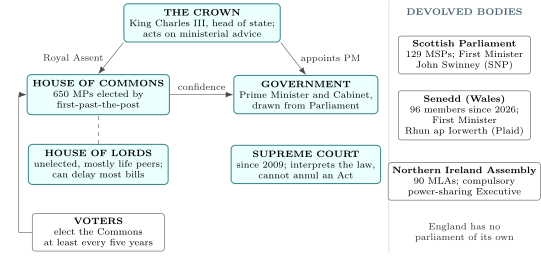
Figure 1. How power is organised in the United Kingdom. The ``efficient'' heart of the system is the link between the Commons and the government: the Prime Minister governs as long as he keeps the confidence of the Commons. On the right, the three devolved legislatures (figures from parliament.scot, senedd.wales and niassembly.gov.uk, 2026). À retenir : Westminster reste souverain et pourrait en droit supprimer les assemblées dévolues, mais aucun gouvernement ne s'y risquerait sans leur consentement.
11.2 Parties and elections: from the 2024 landslide to a fragmented map
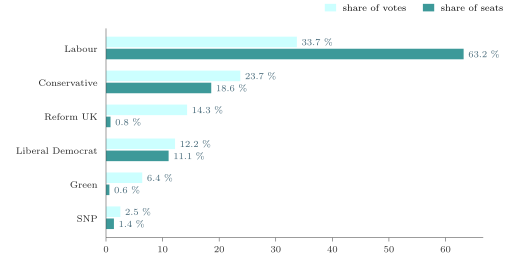
For most of the twentieth century, British politics was a contest between two parties, Conservative and Labour. First-past-the-post rewards large parties whose voters are spread efficiently, and punishes small parties whose voters are scattered. The general election of 4 July 2024 showed both sides of that rule more clearly than any election before it.
Repère : The general election of 4 July 2024
Labour, led by Keir Starmer, won 411 of the 650 seats with 33.7 % of the vote; the Conservatives fell to 121 seats (23.7 %), their worst result ever. The Liberal Democrats won 72 seats (12.2 %). Reform UK won 14.3 % of the vote but only 5 seats; the Greens 6.4 % and 4 seats. The Scottish National Party fell to 9 seats. Turnout was 59.7 %, the lowest at a general election since 2001. Sources: electionresults.parliament.uk; House of Commons Library, which calls the gap between Labour's vote share and its 63.2 % of seats ``the most disproportionate on record''.
Exercices du chapitre
- Un thème de cinq phrases corrigé
- Une version sur le NHS corrigé
- Repérer les fautes corrigé
- Réécrire en C1 corrigé
- Un résumé comparatif en format réduit corrigé
- Un plan d'essai et son introduction corrigé