The United States: institutions, politics, economy and society
Cours · anglais LV A et LV B (prépas ECG et ECT), chapitre 12 · prépas ECG et ECT, 1re et 2e années · le début du chapitre, la suite sur Adloun
The United States is the world's largest economy, its leading military power, and the source of most of the debates that end up in British and French newspapers: on trade, technology, immigration, inequality or the limits of presidential power. It is also a country that French candidates often describe through clichés, either admiring or hostile. A good essay does neither: it explains how American institutions work, and uses precise, dated, sourced facts.
This chapter covers the Constitution and the separation of powers, the party system and its polarisation, the 2024 election and the first two years of the second Trump administration, then the economy and the great social debates. It was written in November 2026: the results of the midterm elections of 3 November 2026 were not yet certified, and they are not discussed here.
ELVi (LV A and LV B): American politics, trade policy and social questions are among the most frequent subjects of the essai argumenté and of the documents of the résumé. Ecricome: the civilisational essay subject often deals with the United States; the thème journalistique of LV2 regularly uses American political vocabulary. Learn the vocabulary boxes both ways, and above all learn to distinguish facts (a law, a ruling, a figure) from commentary.
12.1 The Constitution: a republic built on distrust of power
The Constitution was drafted in Philadelphia in 1787 and came into force in
- It is the oldest written national constitution still in use. The first ten amendments, the Bill of Rights (1791), protect freedom of speech and religion (First Amendment), the right to bear arms (Second Amendment) and the rights of the accused. Only twenty-seven amendments have been adopted in more than two centuries, because the procedure is extremely demanding: two thirds of both houses of Congress, then three quarters of the states.
The separation of powers gives legislative power to Congress, executive power to the President and judicial power to the courts. Checks and balances allow each branch to limit the others: the President can veto a bill, Congress can override the veto and must approve the budget, the Senate confirms judges and ministers, the courts can strike down laws and executive actions that violate the Constitution.
Auteur : James Madison, The Federalist, No. 51 (1788)
Madison defended the Constitution by explaining that liberty depends less on the virtue of leaders than on the rivalry between institutions. His formula is still quoted in every debate on presidential power: Ambition must be made to counteract ambition.'' And a few lines further:
Federalism. The United States is a federation of fifty states. The Tenth Amendment reserves to the states, or to the people, all powers not delegated to the federal government. States therefore control most criminal law, education, elections and, since 2022, abortion law. This is why American life differs so much from one state to another, and why governors and state legislatures matter as much as Washington in many debates.
Auteur : Alexis de Tocqueville, De la démocratie en Amérique (1835–1840)
The French aristocrat who travelled through the United States in 1831 remains the most quoted foreign observer of the country. He saw in the equality of conditions'' the defining feature of American society, admired the habit of forming voluntary associations to solve local problems, and warned against a
12.2 The three branches
Congress
Congress has two chambers. The House of Representatives has 435 members, elected every two years in districts of roughly equal population. The Senate has 100 senators, two per state whatever its population, elected for six years, a third of them every two years. A bill must pass both chambers in the same terms. In the Senate, most bills need 60 votes to end debate, because of the filibuster; budget ``reconciliation'' bills are an exception and can pass with a simple majority.
Congress votes the federal budget through annual appropriations bills. When they are not passed in time, the federal government ``shuts down'': services judged non-essential stop and many civil servants are sent home without pay until a deal is reached. The consequences can be very concrete. In autumn 2025, a shutdown prevented the Bureau of Labor Statistics from collecting its October household survey, so that its annual figures for 2025 had to be computed on eleven months (BLS, Union Members, 2025). For an essay, a shutdown is the clearest illustration of gridlock: two branches that must agree, and neither of which can force the other.
The presidency
The President is head of state and head of government, commander in chief, and is elected for four years; since the Twenty-second Amendment (1951), no one can be elected more than twice. The President cannot dissolve Congress and does not sit in it. Presidential power has grown through executive orders, instructions to the federal administration published in the Federal Register, which do not need a vote of Congress but must rest on the Constitution or on a law.
The Supreme Court
The Supreme Court has nine justices, nominated by the President, confirmed by the Senate and appointed for life. Since Marbury v. Madison (1803), it can declare laws unconstitutional: this is judicial review. Six of the nine current justices were appointed by Republican Presidents, which explains a series of conservative rulings, such as Dobbs v. Jackson (2022), which ended the federal right to abortion recognised in Roe v. Wade (1973).
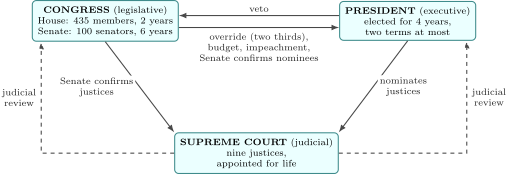
Figure 1. Checks and balances. Each arrow is a power of control of one branch over another; dashed arrows show judicial review, by which the courts can strike down a law or an executive action. The voters elect Congress and, through the Electoral College, the President; they do not elect the justices. À retenir : le système est conçu pour ralentir la décision ; un président sans majorité au Congrès gouverne surtout par décrets, que les tribunaux peuvent suspendre.
Repère : Vocabulary: institutions
| English | Français |
|---|---|
| the Founding Fathers, the Framers | les Pères fondateurs, les rédacteurs |
| an amendment | un amendement (à la Constitution) |
| the federal government | l'État fédéral |
| a lawmaker, a senator, a representative | un parlementaire, un sénateur, un représentant |
| to veto a bill, to override a veto | opposer son veto, passer outre au veto |
| an executive order | un décret présidentiel |
| the administration | le gouvernement (l'exécutif d'un président) |
| a justice, a ruling, a dissent | un juge de la Cour suprême, un arrêt, une opinion dissidente |
| to strike down a law | invalider une loi |
| to impeach | mettre en accusation (destitution) |
Exercices du chapitre
- Un thème de cinq phrases corrigé
- Une version : Lincoln à Gettysburg corrigé
- Repérer les fautes corrigé
- Réécrire en C1 corrigé
- Un résumé comparatif en format réduit corrigé
- Un plan d'essai et son introduction corrigé